 Food
Food Dairy & Poultry
 Beverage
 Home Care
 Beauty & Personal Care
 Health Care & Pharma
 Transport & Logistics
 Automobile
 Aviation
 Retail
 Exhibitions & Events
 Metal
Metal Garment
 Office Supplies
 Consumer Electronics


A pharmaceutical label fails long before it peels off. It fails when a barcode does not scan on a fast packaging line, when variable data smears after sterilization, when tamper evidence is unclear, or when a small formatting error creates compliance risk across a batch. That is why choosing the best labels for pharmaceutical packaging is not a design decision alone. It is a packaging, operations, compliance, and brand protection decision.
In regulated environments, the label has to do several jobs at once. It must carry mandatory information with precision, stay legible through distribution and storage, support traceability, and protect product integrity. For many pharmaceutical manufacturers, the right answer is not one label type, but a label system matched to product format, substrate, application speed, and market requirements.
What makes the best labels for pharmaceutical packaging?
The best labels for pharmaceutical packaging combine five core characteristics: print clarity, adhesive reliability, material durability, serialization readiness, and security performance. If any one of these is weak, the label may still look acceptable at dispatch but underperform in real-world use.
Print clarity matters because pharmaceutical packaging often carries dense content in limited space. Batch numbers, expiry dates, dosage instructions, caution statements, barcodes, and regulatory text all need sharp reproduction. Fine lines, small characters, and variable data printing must remain readable throughout handling.
Adhesive reliability is equally critical. Pharmaceutical products move through varied environments, including cold chain storage, high-speed application lines, humid warehouses, and frequent handling. A label that lifts at the edge or tunnels on curved containers can disrupt both presentation and compliance.
Durability depends on use conditions. A carton label and a label for a plastic bottle may face very different friction, temperature, and moisture exposure. The material and topcoat need to match that environment rather than rely on a generic specification.
Serialization readiness has become a non-negotiable factor in many pharmaceutical supply chains. Labels must support variable data, machine-readable codes, and consistent scan performance. This is especially relevant where secondary packaging, shipper labels, and aggregation workflows are tightly integrated.
Security performance matters because pharmaceuticals remain a high-risk category for diversion and counterfeiting. A standard product label may carry the brand, but a security-integrated label supports product authentication and tamper visibility in a way standard decoration cannot.
Pressure-sensitive labels remain the core choice
For most primary and secondary pharmaceutical applications, pressure-sensitive labels continue to be the most practical format. They support high-volume application, strong print quality, and compatibility with a wide range of substrates, including bottles, jars, vials, cartons, and pouches.
Their flexibility is the main advantage. A pressure-sensitive construction can be engineered for glass, HDPE, PET, coated cartons, or specialty packaging surfaces. It can also be optimized for cold application, condensation resistance, or aggressive adhesion where standard constructions may fail.
That said, not every pressure-sensitive label performs the same way. In pharmaceutical packaging, face stock selection, adhesive chemistry, liner stability, and print method all affect downstream results. A label that runs smoothly on one applicator may not perform well on another if dispensing speed, die-cut precision, or release values are not aligned.
Tamper-evident labels are essential where product integrity is visible
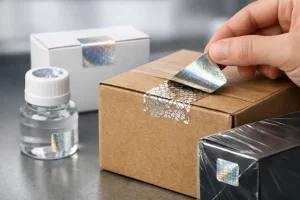
When packaging needs to show clear evidence of opening or interference, tamper-evident labels are often the best fit. These labels are widely used on cartons, bottle caps, closures, and outer packs where visible breach indication supports both compliance and consumer confidence.
The right tamper-evident solution depends on the pack structure. A seal across a carton flap serves a different purpose than a destructible label over a bottle closure. Some applications need clean visual damage on removal. Others need residue transfer, void messaging, or fiber tear to make tampering immediately obvious.
The trade-off is that stronger security features may affect line setup, substrate compatibility, or pack aesthetics. That is why tamper-evident labels work best when developed as part of the packaging specification rather than added late as a corrective measure.
Barcode and variable data labels support traceability
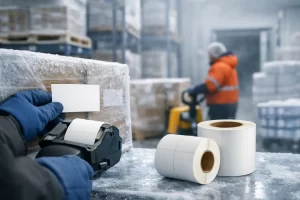
Pharmaceutical operations depend on accurate identification at every stage, from production and warehousing to distribution and recall readiness. Barcode labels and variable data labels play a central role here, especially for secondary packaging, tertiary packs, and logistics units.
The priority is not simply printing a code. It is maintaining consistent scan accuracy under real operating conditions. Label material, ink performance, contrast, print resolution, and surface reflectivity all influence scanner readability. If a code prints well in inspection but fails in a distribution center, the label has already underperformed.
For high-throughput lines, variable data capability also needs to keep pace with production speed. Batch coding, lot numbers, serial numbers, and expiry dates must be applied with precision and remain legible after abrasion, refrigeration, and transport.
RFID labels are gaining value in controlled pharmaceutical supply chains
RFID is not required for every pharmaceutical product, but in the right use case, it can add measurable operational value. For high-value products, controlled inventories, and closed-loop logistics, RFID labels improve inventory visibility, reduce manual scanning dependence, and support faster movement through checkpoints.
The benefit is strongest where enterprises need item-level or case-level visibility beyond standard barcode workflows. RFID can support warehouse accuracy, authentication workflows, and automated tracking. In pharmaceutical environments, that matters when products are sensitive, expensive, or tightly regulated.
Still, RFID is not automatically the best answer. It increases technical complexity and requires alignment across packaging design, readers, software systems, and supply chain infrastructure. Where the network is not ready, a high-performance barcode strategy may remain the better operational choice.
Shrink sleeves work when information space and shelf impact matter
Shrink sleeves are less common than standard labels in many pharmaceutical categories, but they can be highly effective for selected OTC, wellness, and consumer-facing healthcare products. They offer 360-degree decoration and expanded communication space, which is useful when branding, multilingual information, and on-pack differentiation all need room.
They can also provide a tamper-evident function when designed to cover closures. For products sold through retail channels, this can combine visual presence with security.
The limitation is that shrink sleeves demand careful control of container shape, shrink behavior, artwork distortion, and application consistency. For highly regulated packs with dense mandatory content, sleeves must be engineered with readability and registration as the first priority, not just appearance.
Security labels matter more than many teams assume
Counterfeit risk in pharmaceuticals is not theoretical. It affects patient safety, brand trust, and channel confidence. Security labels such as hologram labels, void stickers, and destructible constructions are often among the best labels for pharmaceutical packaging when product authentication is part of the packaging objective.
These labels are especially relevant for premium therapies, export markets, and products moving through fragmented distribution channels. They create visible and, in some cases, covert barriers against tampering and duplication.
The strongest approach usually combines overt and functional elements. A hologram alone may improve recognition, but paired with serialization, tamper evidence, and controlled print features, it becomes a more effective brand protection tool. Security works best as a layered strategy, not a single visual add-on.
Material and adhesive selection should follow the pack environment
The same label construction should not be used across every pharmaceutical SKU by default. Vials, ampoules, blister cartons, syrup bottles, and shippers all create different performance demands.
Paper labels can be suitable for dry secondary packs where print quality and efficient application are the priority. Filmic labels are often better for moisture exposure, chemical resistance, and long-term durability on primary containers. Specialty adhesives may be required for low-temperature application, curved surfaces, or difficult plastics.
This is where experienced label manufacturing becomes commercially valuable. The label must match not just the package, but the line speed, storage condition, transport cycle, and compliance requirement. A technically sound label program reduces rework, scan failures, returns, and packaging interruptions.
How pharmaceutical manufacturers should choose the right label mix
For most manufacturers, the best path is to define the label architecture by application layer. Primary pack labels need strong adhesion, legibility, and resistance to handling. Secondary pack labels need excellent print fidelity and support for traceability data. Tertiary and logistics labels need scan reliability and warehouse durability. Security labels need clear authentication logic and tamper performance.
This layered view prevents a common mistake: selecting one label format based on appearance or unit-level convenience and forcing it across the entire packaging system. Pharmaceutical packaging performs better when each label type is specified for its actual function.
The manufacturing partner also matters. Pharmaceutical labeling requires print consistency, tight quality control, material knowledge, and the ability to scale without introducing variation. A supplier with deep experience in industrial and security labeling is often better equipped to support validation, repeatability, and long-run production discipline.
For enterprise buyers, the question is not simply which label looks best on the pack. It is which label continues performing after filling, coding, shipping, handling, inspection, and market exposure. That is the standard the category demands.
The best pharmaceutical label is the one that keeps critical information clear, product integrity visible, and traceability intact without slowing the line or creating risk later. When those conditions are met, the label stops being a packaging component and starts functioning as part of the product’s control system.