 Food
Food Dairy & Poultry
 Beverage
 Home Care
 Beauty & Personal Care
 Health Care & Pharma
 Transport & Logistics
 Automobile
 Aviation
 Retail
 Exhibitions & Events
 Metal
Metal Garment
 Office Supplies
 Consumer Electronics

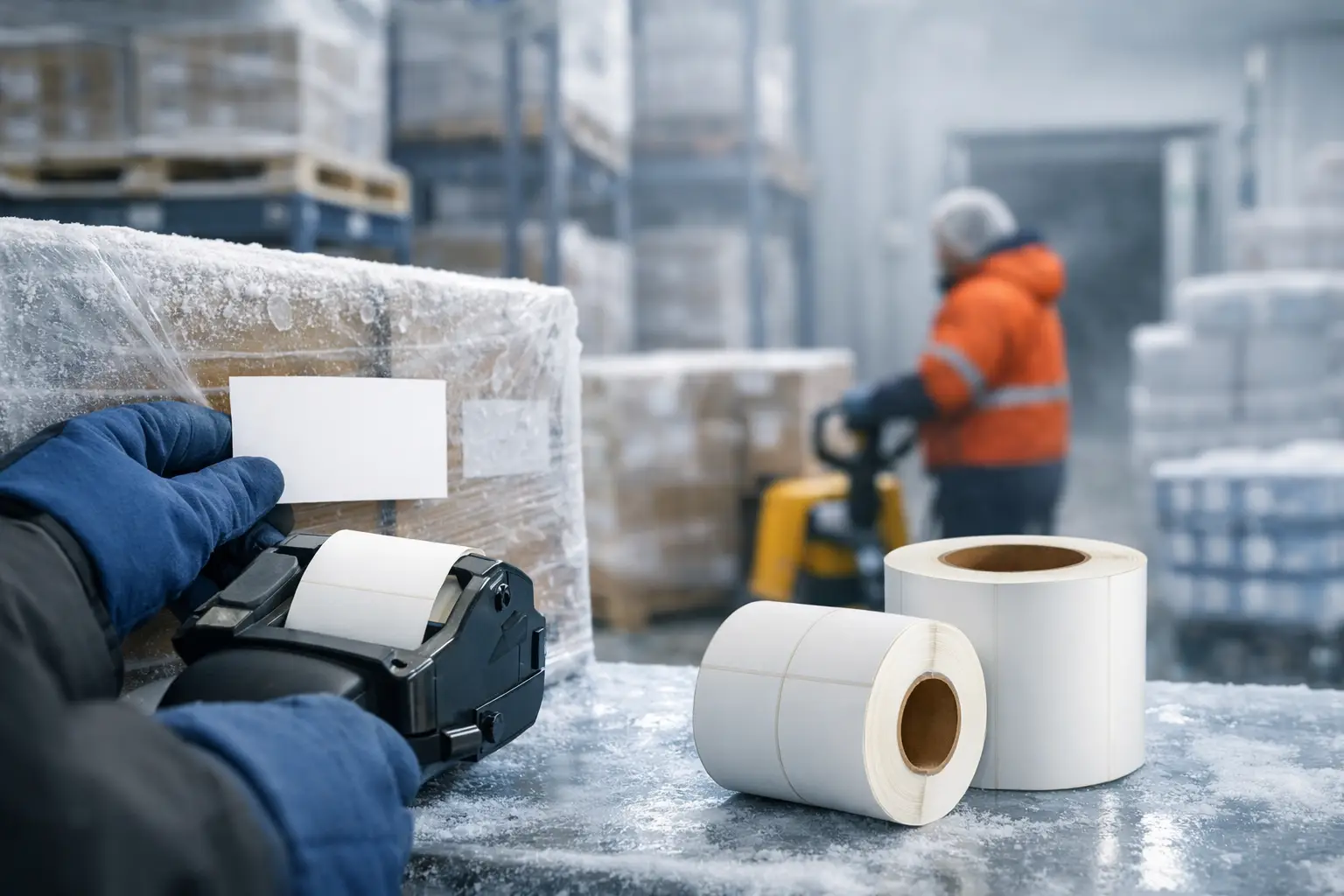
A barcode that scans perfectly at packing can fail completely after a few hours in a blast freezer. That single failure can slow picking, break traceability, trigger relabeling, and create avoidable waste. Choosing the best labels for cold storage is not about selecting a generic freezer-safe product. It is about matching adhesive, facestock, print method, and application conditions to the actual environment your operation runs every day.
For food processors, pharmaceutical manufacturers, dairy plants, cold chain logistics providers, and export-oriented packaging operations, label performance in low-temperature environments is a functional requirement. If the label lifts, smears, cracks, or becomes unreadable, the issue is not cosmetic. It affects compliance, inventory accuracy, and throughput.
What makes cold storage labeling difficult
Cold storage is not one single condition. A chilled warehouse, a frozen distribution center, a deep freezer, and a blast freezing line all place different stresses on a label. Temperature is only part of the equation. Moisture, condensation, frost, surface texture, handling abrasion, and chemical exposure all influence whether a label stays attached and readable.
This is where many procurement and operations teams run into trouble. A label may be technically rated for low temperatures, but that does not guarantee performance if it is applied to a damp corrugated carton, a curved plastic container, or a flexible film pouch straight off a cold filling line. The best labels for cold storage are engineered around the full process, not just the storage temperature listed on a specification sheet.
Application temperature is one of the most overlooked variables. Some labels perform well once they are in frozen storage but fail because they were applied in an environment too cold for the adhesive to wet out properly. Others bond initially but lose grip when condensation forms during movement between temperature zones.
The best labels for cold storage depend on four factors
There is no universal label stock that outperforms every other option in every cold chain setting. The right construction depends on four decisions: what surface the label is applied to, how cold the product environment gets, what information the label must carry, and how long the label needs to remain functional.
A smooth HDPE container behaves differently from corrugated board. A pharmaceutical vial requires a different label construction than a pallet identification tag. A short-life internal warehouse label does not need the same material durability as a traceability label that must survive production, storage, transport, and end-user handling.
That is why enterprise buyers should evaluate labels as application-specific components rather than commodity consumables. In cold storage, the margin for error is smaller.
Adhesive is the first performance decision
For cold storage labels, adhesive selection matters more than many buyers expect. Permanent freezer-grade adhesives are commonly the right choice when labels must remain fixed through chilling, freezing, and transport. These adhesives are designed to maintain bond strength at low service temperatures and on challenging substrates.
But even within that category, performance varies. Some adhesives are better for already-frozen application, while others are intended for room-temperature application before products enter cold storage. If your operation labels after pre-cooling, freezer-grade adhesive alone may not be enough. You need an adhesive designed for low-temperature application, not just low-temperature service.
Removable adhesives can also have a place in cold storage, though usually in controlled internal workflows where relabeling is expected and residue control matters. For most traceability and compliance use cases, permanent adhesion is the safer path.
Facestock choice affects durability and readability
Paper labels can work in chilled environments if exposure is limited and moisture is controlled, but they are often a weak choice for demanding freezer conditions. Paper absorbs moisture, can wrinkle, and may lose integrity when repeatedly exposed to condensation or frost.
Film labels, especially polypropylene and polyester constructions, are generally better suited to cold storage operations. They resist moisture, maintain dimensional stability, and support sharper print durability under handling stress. For high-contact operations, film facestocks usually provide better long-term performance than paper alternatives.
The trade-off is that not every film behaves the same way on every package type. Flexible packaging, rigid containers, cartons, and returnable crates each require a slightly different performance balance between conformability, stiffness, and adhesive compatibility.
Print technology must survive the environment
Cold storage labels do not fail only because they fall off. They also fail when variable data becomes unreadable. Barcodes, batch codes, expiry details, and handling instructions must remain clear across low temperatures and repeated movement through the supply chain.
Thermal transfer printing is often preferred for warehouse and logistics labels because it can deliver durable variable information when paired with the right ribbon and facestock. Direct thermal labels, while useful in some short-cycle operations, are less reliable for longer cold chain exposure because image stability can degrade over time or under friction.
For branded packaging and pre-printed identification labels, flexographic and digital print methods each have value depending on volume, design complexity, and data requirements. The key is not just print quality at dispatch, but print legibility after storage, handling, and transport.
The substrate changes everything
A label that performs well on plastic may fail on corrugated board. Cartons stored in freezers often face moisture-related surface changes, and recycled board can create additional bonding inconsistency. Plastic tubs, glass containers, metal surfaces, shrink-wrapped packs, and flexible films each demand different adhesive behavior.
This is why substrate testing matters. In industrial environments, label qualification should reflect the real packaging material, actual application temperature, expected dwell time, and full storage cycle. Laboratory claims are useful, but production validation is what prevents operational failure.
Common cold storage use cases and what works best
In food and beverage environments, pallet labels and outer-case barcode labels need strong scan reliability and firm adhesion on corrugated surfaces. These applications often benefit from freezer-grade adhesives and durable top-coated materials that can withstand condensation during loading and unloading.
In dairy, poultry, and frozen foods, primary packaging labels frequently face water exposure, low temperatures, and handling abrasion. Filmic self-adhesive labels are often a stronger fit here, especially where brand presentation and regulatory print must remain intact through distribution.
In pharmaceuticals and healthcare cold chain operations, label performance is tied directly to compliance and traceability. Legibility, batch accuracy, and resistance to smudging are not optional. Materials with strong print anchorage and controlled adhesive performance are typically necessary, especially for small containers and secondary packs.
In cold chain logistics, large-format barcode and RFID-enabled labels may be required for faster scanning and warehouse visibility. Here, the best label is not only durable but operationally compatible with automation, scanning infrastructure, and inventory systems.
How to evaluate the best labels for cold storage before rollout
The most effective approach is controlled testing under real conditions. Start with the exact package material and apply labels at the actual line temperature. Then expose them to your true storage environment, including freeze-thaw transitions if those occur in distribution.
Check more than adhesion. Test barcode readability, print durability, edge lift, container conformity, and performance after handling. If cartons are stacked, rubbed, or shrink wrapped, that needs to be part of the trial. If labels are applied by machine, dispensability and release characteristics should also be validated.
This evaluation stage is where an experienced manufacturing partner adds measurable value. A supplier that understands industrial labeling will recommend constructions based on service conditions, not generic catalog categories. For high-volume operations, that reduces the risk of expensive relabeling, scan failures, and rejected shipments.
Why custom specification beats off-the-shelf selection
Cold storage labeling is one of those applications where standardization helps only up to a point. Once your environment includes mixed packaging formats, export conditions, compliance requirements, or automated application lines, a custom specification often produces better operational results than a stock label.
A precision-engineered label can be built around adhesive behavior, material gauge, print method, release liner performance, and data requirements. That matters when labels must support both branding and industrial traceability. It also matters when you need consistency across multiple facilities or geographies with different handling conditions.
For enterprise buyers, this is less about buying a label and more about securing a dependable identification system. Kimoha operates in that space by aligning material and print decisions with end-use performance, especially where durability and accuracy cannot be left to assumption.
The right cold storage label should disappear into the workflow. It should stay attached, scan on demand, remain legible, and keep supporting compliance without drawing attention to itself. When that happens, operations move faster, errors drop, and the label does the job it was meant to do – quietly, accurately, and every time the temperature falls.