
 Food
Food Dairy & Poultry
 Beverage
 Home Care
 Beauty & Personal Care
 Health Care & Pharma
 Transport & Logistics
 Automobile
 Aviation
 Retail
 Exhibitions & Events
 Metal
Metal Garment
 Office Supplies
 Consumer Electronics

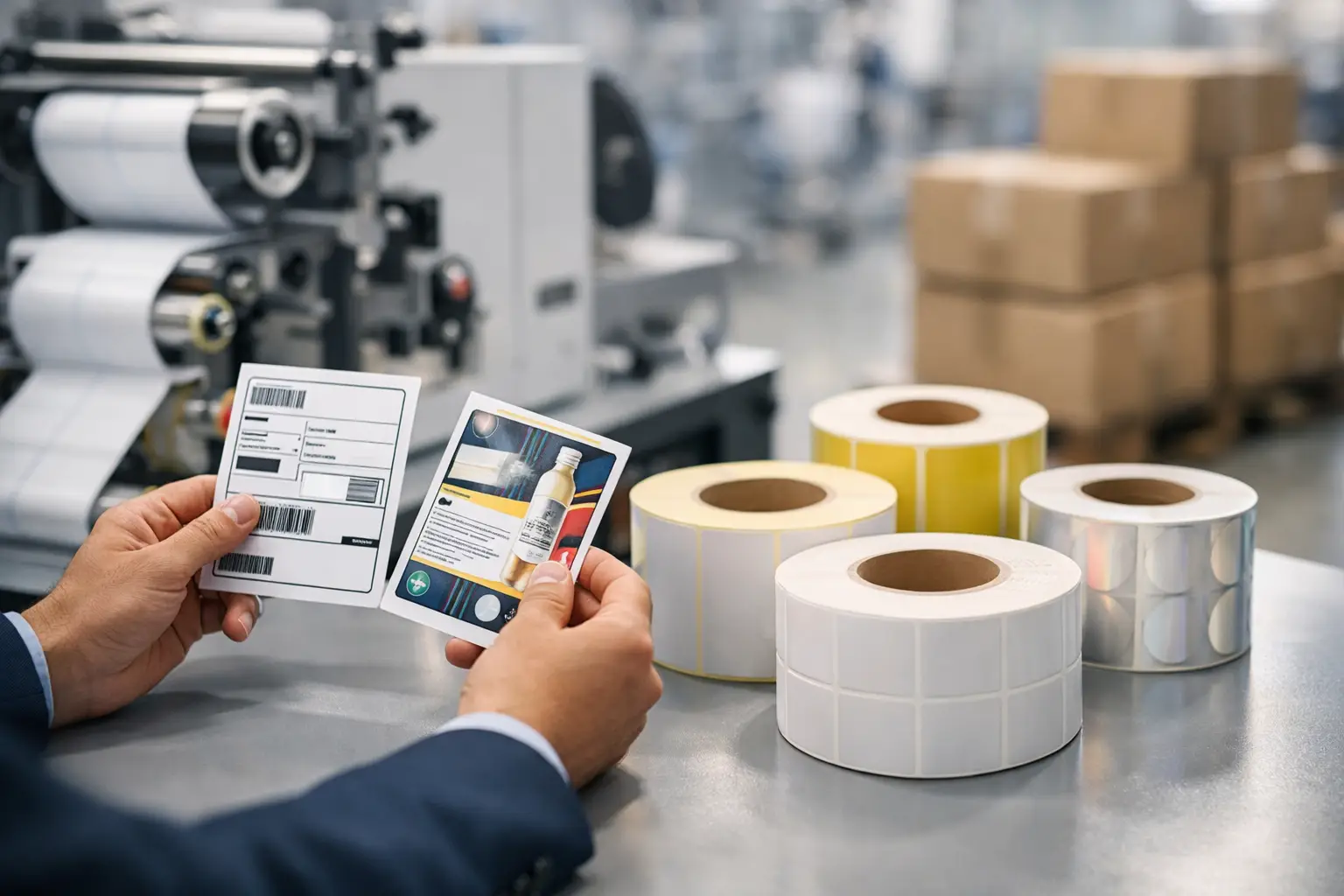
A missed scan at a distribution hub rarely looks like a label problem at first. It shows up as a shipment exception, a receiving delay, an inventory mismatch, or a customer complaint. That is why choosing the right custom logistics labels supplier is not a routine procurement task. It is an operational decision that affects traceability, throughput, compliance, and brand control across the supply chain.
In logistics environments, labels are exposed to abrasion, moisture, handling stress, temperature variation, warehouse dust, and repeated scanning. They must stay legible, remain adhered to the right surface, and integrate with systems that depend on barcode accuracy, variable data, and sometimes RFID functionality. A supplier that only prints to specification is not enough. The stronger partner understands how labels perform in motion, under pressure, and at scale.
What a custom logistics labels supplier should actually deliver
A capable supplier does more than convert artwork into printed stock. In logistics, customization begins with the application environment. Cartons, stretch wrap, polybags, drums, pallets, cold-chain packaging, and returnable transport items all behave differently. The face material, adhesive, liner, print method, and finishing decisions must reflect those differences.
This is where many buying decisions become more technical than they first appear. A label that works well on clean corrugate in a dry warehouse may fail on low-surface-energy packaging, chilled surfaces, or high-speed automatic application lines. Likewise, a barcode that scans cleanly at pack-out can degrade after scuffing in transit if print quality and topcoat selection are not engineered properly.
A strong supplier should be able to discuss substrate compatibility, adhesive performance, print durability, scanner readability, and serialization requirements with confidence. That technical fluency matters because logistics labels are rarely standalone items. They are part of a larger identification system tied to WMS, ERP, shipping software, compliance documentation, and customer-specific routing requirements.
Why customization matters in logistics labeling
Standard labels can support simple shipping tasks, but logistics operations are rarely simple for long. Once volumes increase, SKUs expand, or channel requirements vary, generic stock starts creating friction. Customization reduces that friction by aligning the label with the actual movement of goods.
For some businesses, the need is durability. A pallet label may need to survive long-distance transport, rough handling, and outdoor exposure before final receipt. For others, the issue is data density. Small-package formats often require compact layouts carrying barcodes, batch codes, product descriptions, and regulatory information without compromising scan performance. In regulated sectors, the stakes are higher still. Traceability data must remain accurate and readable throughout the product journey.
Customization also affects application efficiency. Label dimensions, roll direction, core size, adhesive tack, and release characteristics all influence how smoothly labels run through dispensing equipment. If these details are not aligned with the production line, downtime follows. The label itself may be small, but its effect on line efficiency is not.
Key capabilities to evaluate in a custom logistics labels supplier
The first capability is material and adhesive expertise. Logistics labels must match the surface and environment, not just the design. Paper labels may suit controlled indoor use, while filmic constructions are often better for moisture, chemicals, or abrasion. Permanent adhesives work for long-term identification, but removable or repositionable options may be necessary for temporary routing, tote tracking, or rework operations.
The second is print precision. Barcode labels, sequential numbering, variable data, and high-contrast text all demand print consistency. In high-volume operations, even slight variation can create scanning failures or readability issues. Suppliers with advanced flexographic and digital capabilities are better positioned to manage both scale and precision, especially when jobs combine static branding with variable logistics data.
The third is converting and format control. A label may have perfect print quality and still create problems if the roll construction does not suit the application machinery. Width tolerances, die-cut accuracy, matrix removal, perforation quality, and rewind orientation all influence operational performance. Enterprise buyers should expect detailed control over these specifications rather than generic supply.
The fourth is security and traceability support. In some logistics chains, labels are not just identifiers. They are control points. Tamper-evident constructions, void materials, holographic features, serialized barcodes, and RFID-enabled formats help protect products, validate handling, and support chain-of-custody requirements. This is especially relevant in aviation, pharmaceuticals, electronics, and high-value retail distribution.
The trade-offs buyers should consider
There is no single best logistics label for every operation. The right construction depends on what matters most in the field.
For example, a highly aggressive adhesive can improve retention on difficult surfaces, but it may create issues where clean removal is needed. A durable synthetic face stock can improve resistance to moisture and abrasion, but it may be unnecessary for short-cycle indoor movement. Digital printing supports variable data and shorter changeovers efficiently, while flexographic production can be better suited to larger standardized runs. The smart decision is not choosing the most advanced option by default. It is choosing the construction that fits the workflow, risk profile, and operating conditions.
This is where supplier guidance matters. Buyers should be cautious of one-size-fits-all recommendations. A supplier with real sector experience will ask about storage conditions, transit exposure, scanning equipment, line speed, packaging substrate, and end-user handling before suggesting a specification.
Custom logistics labels supplier selection for enterprise buyers
For procurement, operations, and quality teams, supplier evaluation should move beyond sample appearance. A label can look correct on a desk and still underperform in production. The better assessment is performance-based.
Ask how the supplier validates barcode readability and print consistency across volumes. Review their ability to support variable information, serialized data, and multiple SKUs without quality drift. Confirm whether they can maintain repeatability across repeat orders, because labeling inconsistency across batches creates avoidable complexity on the warehouse floor.
It is also worth evaluating the supplier’s range. Logistics labeling often expands over time. A business may begin with carton and shipping labels, then require pallet identifiers, division labels, RFID labels, tamper-evident formats, or integrated packaging identification for different business units. A supplier with broad industrial labeling capability can support that evolution more effectively than a narrow print vendor.
Manufacturing maturity matters as well. Established production systems usually bring better process control, stronger documentation discipline, and more reliable scaling under demand. For enterprises operating across India, the United States, Europe, the United Kingdom, Australia, Africa, and wider Asian markets, consistency becomes even more important when labeling standards must support multi-location operations and varied shipping conditions.
Where logistics labels fail most often
Most failures come from mismatch, not from printing alone. The adhesive does not match the surface. The face stock cannot handle the environment. The print is technically readable but not durable enough for transit. The label layout works visually but not for scanner performance. Or the roll format does not suit the application equipment.
Another common issue is underestimating data complexity. Logistics labels often carry more than shipping information. They may need SKU data, lot traceability, destination coding, compliance elements, and internal handling instructions in a limited area. If the design is crowded without regard for scanner contrast, quiet zones, and hierarchy, readability drops fast.
The final failure point is treating labels as a commodity after launch. Logistics requirements change. New packaging materials are introduced, customer routing guides are updated, warehouse automation increases, and compliance demands tighten. A supplier relationship should be able to adapt with those changes instead of forcing recurring requalification from scratch.
Why the right supplier becomes part of the operation
A good custom logistics labels supplier supports more than fulfillment. It strengthens process reliability. It helps protect scan accuracy, reduce manual intervention, and maintain identification integrity from packing line to final delivery. In sectors where errors carry compliance, safety, or brand risk, that support becomes even more valuable.
This is where a specialist manufacturer stands apart. Companies such as Kimoha, with deep experience in industrial, security, and high-performance label applications, approach logistics labeling as a functional system rather than a printed consumable. That perspective is what enterprise buyers should look for.
When labels are expected to carry data, survive movement, support automation, and protect traceability, the right supplier is not the one that simply says yes to a specification. It is the one that helps make sure the specification works in the real world.