
 Food
Food Dairy & Poultry
 Beverage
 Home Care
 Beauty & Personal Care
 Health Care & Pharma
 Transport & Logistics
 Automobile
 Aviation
 Retail
 Exhibitions & Events
 Metal
Metal Garment
 Office Supplies
 Consumer Electronics

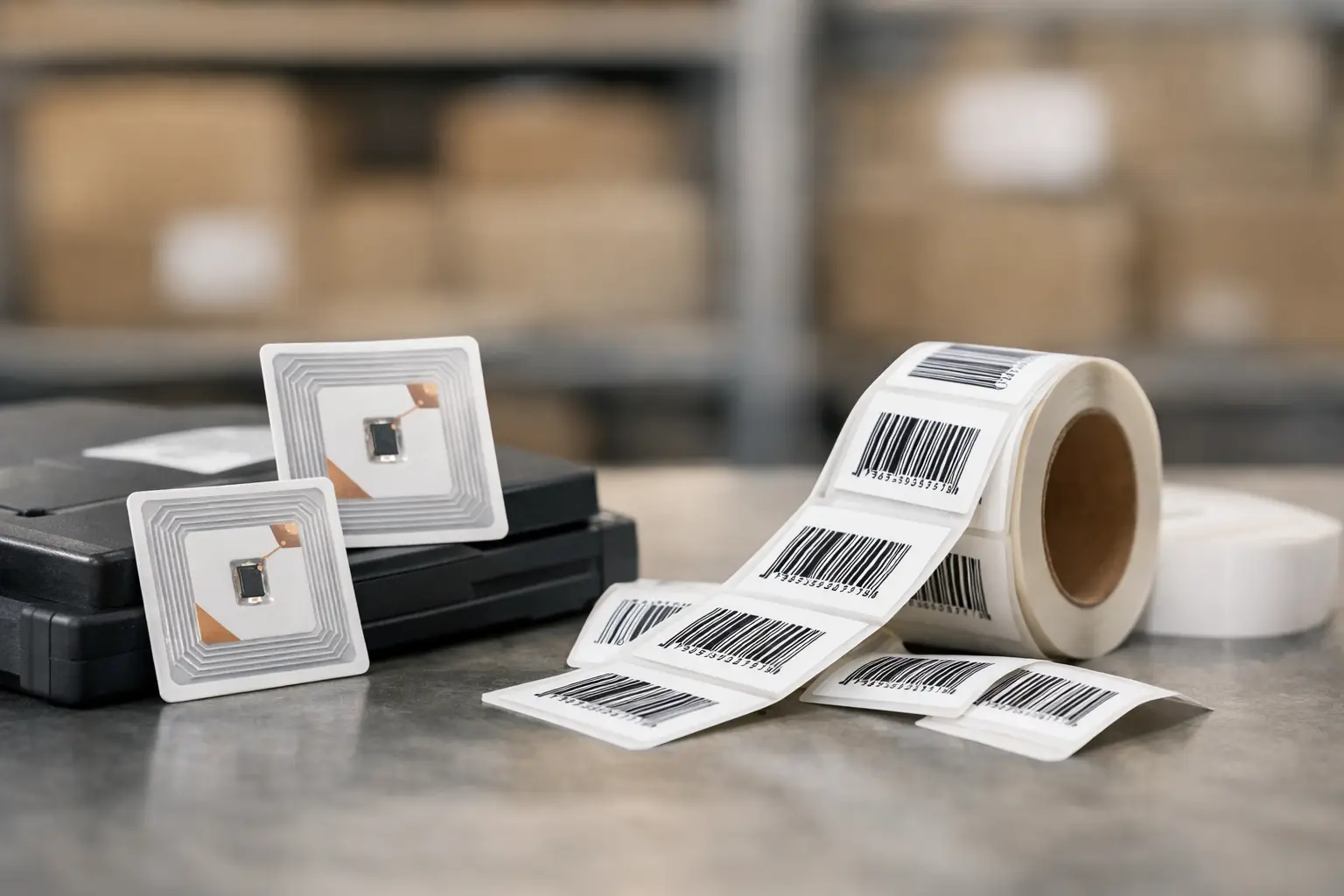
A missed scan on a pallet line can delay dispatch. A manual inventory count can consume an entire shift. When operations teams evaluate RFID vs barcode labels, the real question is not which technology sounds more advanced. It is which one delivers the control, traceability, and throughput your environment actually requires.
For manufacturers, logistics operators, regulated brands, and enterprise buyers, labels are infrastructure. They carry data, support compliance, and influence how quickly goods move through warehouses, production floors, and distribution networks. Choosing between barcode and RFID labeling affects scan speed, labor effort, data accuracy, and long-term process visibility.
RFID vs barcode labels: the core difference
Barcode labels store data in a printed visual pattern that must be scanned line-of-sight using optical readers. RFID labels contain an embedded chip and antenna that transmit data through radio frequency, allowing tags to be read without direct visual alignment.
That single distinction changes how each technology performs in the field. Barcode systems depend on clean printing, proper placement, and operator scanning behavior. RFID systems reduce dependence on line-of-sight, which can improve speed and automation in the right setup. But the right setup matters. RFID is not automatically better in every operation, and barcode is not limited to basic use cases.
Where barcode labels still make strong operational sense
Barcode labels remain the standard across large parts of manufacturing, retail, shipping, warehousing, healthcare, and industrial packaging for a reason. They are practical, established, and highly effective when processes are controlled and scan points are predictable.
In most facilities, barcode labels work well for carton identification, product labels, shelf labeling, shipping labels, work-in-progress tracking, and asset tagging. They integrate easily into existing ERP, WMS, and inventory systems. They are also simple for teams to adopt because scanning behavior is familiar and hardware requirements are straightforward.
For many businesses, the main advantage is process clarity. A barcode is visible, easy to verify, and well suited to point-specific scanning. If your operation only needs confirmation at receiving, packing, dispatch, or retail checkout, a high-performance barcode label can be the most efficient choice.
Durability, however, should not be treated as a given. In industrial conditions, barcode labels must be engineered for the substrate, adhesive surface, print method, and exposure environment. Heat, moisture, chemicals, abrasion, or cold storage can reduce scan reliability if material selection is poor.
Where RFID labels create measurable gains
RFID labels become valuable when manual scanning creates friction or where visibility must extend across larger volumes, faster movement, or less predictable handling conditions. They are especially useful when multiple items need to be identified quickly without scanning each label one by one.
This matters in high-throughput warehousing, returnable transport item tracking, aviation baggage and cargo workflows, retail stock accuracy programs, pharmaceutical traceability environments, and closed-loop industrial systems. RFID can support bulk reads, automated gate scans, and reduced human intervention at key control points.
That said, RFID performance depends heavily on engineering. Tag inlay selection, label construction, reader positioning, material interference, and the presence of metal or liquids all affect readability. An RFID program is only as strong as its application design. In enterprise environments, that makes label construction a technical decision, not a generic consumables purchase.
Accuracy, speed, and labor impact
From an operations perspective, this is often where the comparison becomes practical.
Barcodes are highly accurate when labels are printed correctly and scanned deliberately. The trade-off is labor dependency. Someone or something needs to present the barcode to a reader at the right angle and distance. In lower-volume or controlled workflows, that is manageable. In higher-volume workflows, repetitive scanning can become a bottleneck.
RFID reduces that dependence on manual presentation. Multiple tagged items can be read in seconds, often while moving. This can improve receiving speed, cycle counting, and shipment verification. It can also reduce missed scans caused by rushed handling or obstructed labels.
But speed gains are not universal. If your process already includes a mandatory touchpoint, such as quality verification or manual packing confirmation, barcode scanning may fit naturally with no real productivity penalty. RFID shows its strongest value where removing individual scan events changes labor utilization or improves data capture consistency.
Data capacity and traceability
Barcode labels typically hold a fixed identifier or encoded product data. That is enough for many applications, especially when the main record lives in a connected business system. For serialized traceability, compliance tracking, and standard supply chain identification, barcodes remain effective.
RFID labels can hold more data and support dynamic updates depending on the system design and tag type. More importantly, they can improve how frequently data is captured, because reads can happen automatically at multiple points. That creates a denser event trail across movement, storage, and handling.
For sectors where traceability is operationally critical, not just administratively useful, that difference matters. If a business needs better visibility into asset location, movement history, inventory status, or chain-of-custody events, RFID can support a more automated data environment.
Durability and environment considerations
The question is not whether a barcode or RFID label can survive a tough environment. Both can, if the label is engineered properly. The real issue is how the environment affects readability.
Barcode readability depends on print contrast and surface condition. Smudging, scratching, condensation, and label damage can all interfere with scans. Protective topcoats, suitable facestocks, and the right print technology help reduce that risk.
RFID introduces another layer. The printed label may appear intact while radio performance is compromised by the tagged item, placement, or surrounding materials. Metal surfaces, liquid-filled products, stacked configurations, and dense packaging environments can all influence read performance. In industrial use, label design and testing are essential before rollout.
Compliance, security, and control
In regulated industries, labels do more than identify products. They support auditability, authentication, and process control. Barcode labels perform well in structured compliance systems, especially when paired with serialization, batch coding, and controlled scanning procedures.
RFID can strengthen control in environments that need automated verification or reduced dependence on operator compliance. It may support better monitoring of movement across secure zones, restricted assets, or high-value goods. In some programs, RFID also works well alongside tamper-evident or security-focused label constructions where traceability and protection need to work together.
This is not an either-or decision in every case. Some enterprises use barcode labels for outward-facing supply chain interoperability and RFID for internal automation, asset control, or high-value process checkpoints.
RFID vs barcode labels by use case
If your operation involves predictable scan points, standard shipping workflows, carton labeling, retail packaging, or broad ecosystem compatibility, barcode labels are often the right fit. They are proven, scalable, and easy to operationalize.
If your operation involves bulk reading, non-line-of-sight identification, rapid inventory reconciliation, reusable asset tracking, or automated movement monitoring, RFID may offer stronger long-term process value.
The deciding factor is usually not the label itself. It is the process architecture around it. How many scan events occur each day? Where do errors happen? How much time is spent locating inventory, confirming dispatches, or counting stock? Which failures create business risk – missing data, delayed movement, manual effort, or weak traceability?
When a hybrid labeling strategy works better
Many industrial businesses do not need to choose one technology across the entire operation. A hybrid strategy often delivers better results.
A manufacturer may use barcode labels on finished goods for supply chain compatibility, while applying RFID labels to pallets, returnable containers, or warehouse assets. A pharmaceutical or electronics operation may rely on barcodes for unit-level compliance and RFID for internal material movement. Aviation and logistics environments may combine visible barcode identification with RFID-enabled tracking where speed and handling accuracy are critical.
This approach keeps the labeling program aligned with actual operational value. It also avoids overengineering simple workflows while still improving visibility in high-impact areas.
How to make the right decision
The best choice starts with process mapping, not technology preference. Look at where labels are applied, how items move, who scans them, what surfaces are involved, and where data gaps occur. Then evaluate the environment, throughput, compliance requirements, and system integration needs.
A label supplier with real industrial experience should be able to assess more than print quality. They should understand adhesive performance, substrate selection, readability risks, inlay suitability, application conditions, and the operational role of the label in your wider process. That is particularly important in sectors where failure is expensive, whether the issue is a missed shipment, a traceability gap, a rejected pallet, or a compromised asset record.
For enterprise buyers, RFID vs barcode labels is rarely a question of old versus new. It is a question of fit. The right label technology is the one that performs reliably in your environment, supports your systems, and improves control where your operation needs it most. A well-engineered label does not just identify an item. It strengthens the process around it.