 Food
Food Dairy & Poultry
 Beverage
 Home Care
 Beauty & Personal Care
 Health Care & Pharma
 Transport & Logistics
 Automobile
 Aviation
 Retail
 Exhibitions & Events
 Metal
Metal Garment
 Office Supplies
 Consumer Electronics

Counterfeiting is a global crisis impacting industries from pharmaceuticals to cosmetics. To protect your reputation, you must use anti-counterfeit security labels as a multi-layered shield. In today’s market, a simple label is no longer enough; it must be a formidable tool for brand protection.
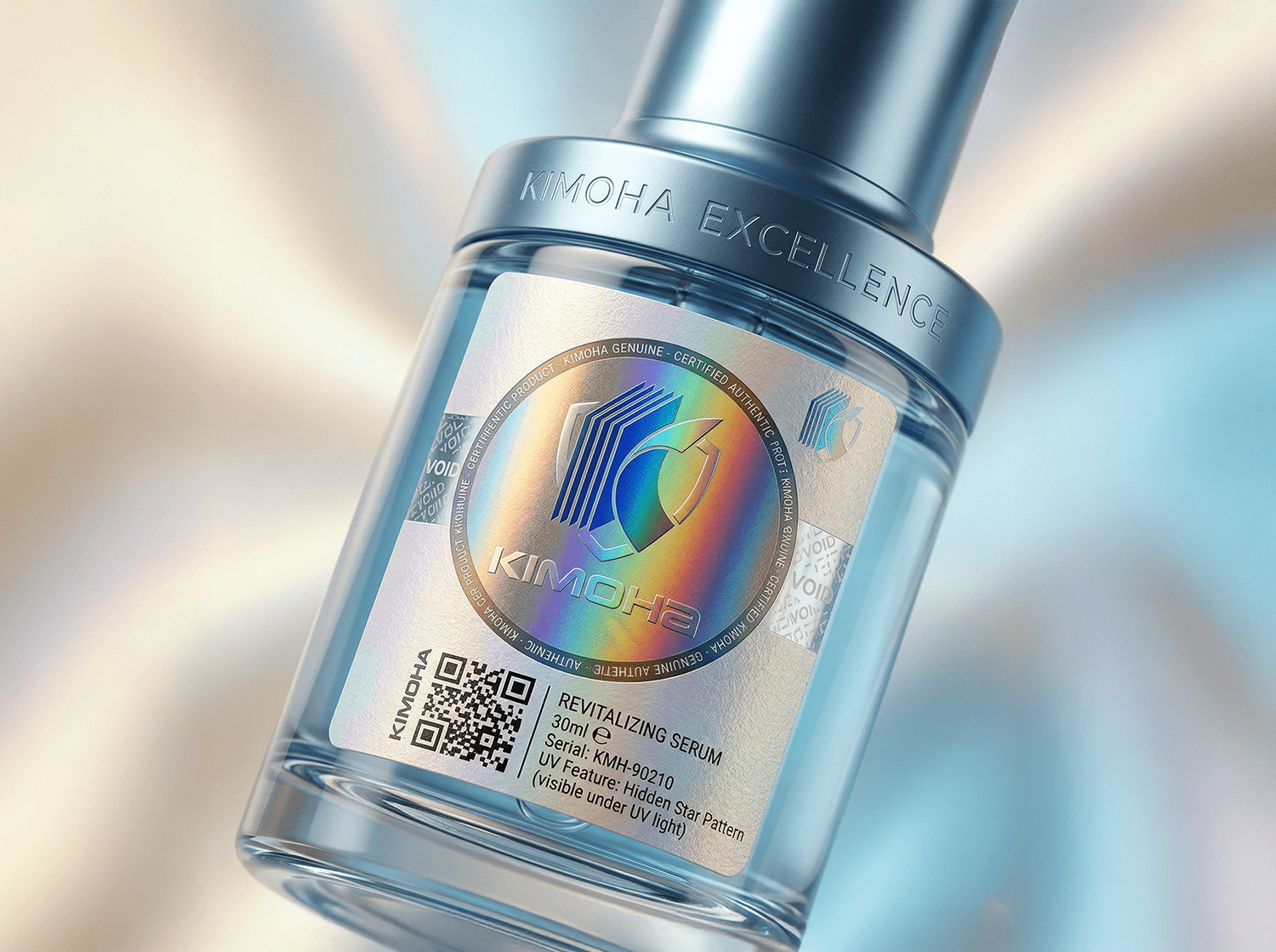
Take, for example, the “KIMOHA EXCELLENCE” matte personal care product shown in our image. Its elegant blue-metal case is just the first layer of brand equity. The true battle against fakes is won (or lost) on the sophisticated, detailed security label seamlessly integrated onto the product body.
An effective Anti-Counterfeit Security Labels Solutions strategy requires a layered approach, and the label is your most powerful overt tool. Let’s deconstruct the components of the highly complex security label on the KIMOHA personal care product to understand what makes it effective.
The Overt Layer: Visible, Hard-to-Copy Anti-Counterfeit Security Labels Solutions
The first and most important feature is the overt, or visible, security measure. The central holographic patch on the KIMOHA label is an excellent exemplar. A well-designed hologram is more than just a shiny sticker; it uses complex, microscopic optical structures to create depth, motion, and color shifts that are prohibitively expensive and technically difficult to replicate.
-
Dynamic Holography: Notice how the word “KIMOHA” is integrated into a multi-layered design that changes and pulses with light. This level of complexity is crucial. Simple, generic patterns are easily copied. A custom-originated holographic design specific to your brand provides a strong first-level authentication that a consumer can verify at a glance.
-
Integrated Branding: The design seamlessly incorporates the brand name “KIMOHA” and the geometric ‘K’ icon. This deep integration makes the label itself a signature of the brand, not just a generic feature slapped on.
The Tactic Layer: Invisible Verification in Anti-Counterfeit Security Labels
The overt layer deters fakes, but a determined counterfeiter may still try to replicate it. This is where covert and forensic features are vital. The text on the KIMOHA label specifically lists a “UV Feature: Hidden Emblem (visible under UV light).” This is a critical security layer.
-
Covert Features (UV/IR Inks): An invisible-to-the-naked-eye feature provides a second, secure point of verification that is invisible to a counterfeiter. An authorized verifier, a customs official, or even a brand representative can use a special UV light to check for a hidden mark, such as a logo or a code. This is a powerful, low-cost internal verification tool.
-
Forensic Features: Though not explicitly detailed, advanced labels can contain covert features (like taggants or DNA-based security) that require specialized laboratory equipment to detect. These provide irrefutable evidence in legal disputes and criminal cases.
The Variable Layer: Unit-Level Traceability and Consumer Verification
A generic security label is good; a label with unique data for every single unit is revolutionary. This is achieved through serialization and variable data printing, two technologies used on the KIMOHA label:
-
Serialized Unique Numbers: Look closely at “Serial: KMC-20330.” This is not a batch number; it’s a unique serial code for this specific personal care product. When combined with a secure database, serialization enables individual product tracking throughout the supply chain and provides definitive proof that a specific unit is authentic.
-
Consumer Interaction with QR Codes: The integration of a QR code is a crucial bridge to consumer empowerment. A consumer can scan the code to instantly connect to a secure verification portal, confirming the product’s authenticity, viewing its origins, and even accessing product information. This builds immense trust and enables direct consumer engagement.
The Integrity Layer: Tamper Evidence
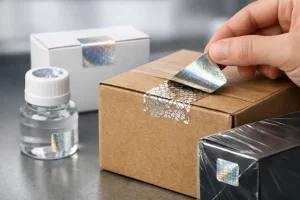
Finally, a security label must be tamper-evident. A sophisticated label that can be cleanly peeled off and reapplied to a fake product is useless. The KIMOHA label provides an answer with the repeating “VOID” pattern in its background design.
-
VOID Inks and Destructible Labels: This isn’t just a design element. This type of label, when peeled, either tears destructively or leaves a pattern (like the word ‘VOID’) behind on the surface, clearly indicating that the product has been opened, reused, or compromised. Tamper evidence is non-negotiable for product safety and brand integrity.
The Integrated Approach: No Single Bullet
There is no “single bullet” that will stop counterfeiting. An effective anti-counterfeit strategy must be multi-faceted and holistic. A security label like the one seen on the KIMOHA personal care product is a masterclass in this approach:
-
Overt: The dynamic, branded hologram (at the core and on the cap).
-
Covert: The invisible UV hidden emblem.
-
Variable/Traceable: The unique serial number and consumer-facing QR code.
-
Tamper-Evident: The ‘VOID’ pattern on the label matrix.
Conclusion: An Investment, Not an Expense
A high-quality, multi-layered security label is not a passive cost; it is a critical investment in your brand’s equity. It protects your revenue, safeguards your legal standing, assures consumer safety, and, most importantly, maintains the priceless trust of your customers.
Do not wait for a counterfeit crisis to damage your reputation. Invest in sophisticated security labels today. They are your signature of authenticity. For consultation on creating your custom security solution, contact a specialized security printing partner.
Check out our complete Security Labels Solution
Check our Pressure Sensitive Labels