 Food
Food Dairy & Poultry
 Beverage
 Home Care
 Beauty & Personal Care
 Health Care & Pharma
 Transport & Logistics
 Automobile
 Aviation
 Retail
 Exhibitions & Events
 Metal
Metal Garment
 Office Supplies
 Consumer Electronics


A package arrives with a broken seal, a lifted label, or a closure that looks slightly disturbed. In many industries, that small visual cue triggers much bigger consequences – rejected inventory, compliance concerns, customer complaints, or questions about product integrity. That is exactly where tamper evident labels for packaging move from being a simple packaging component to a critical control point.
For manufacturers, brand owners, and supply chain teams, tamper-evident labeling is not just about showing that someone interfered with a pack. It is about creating a visible, reliable, and scalable method for protecting products, signaling authenticity, and supporting accountability from filling line to end user. The right label does that quietly, consistently, and at production speed.
What tamper evident labels for packaging actually do
A tamper-evident label is designed to provide visible evidence when a package, carton, container, or closure has been opened, lifted, broken, or manipulated. Unlike a standard decorative or informational label, its job is not only identification. Its primary role is to reveal interference.
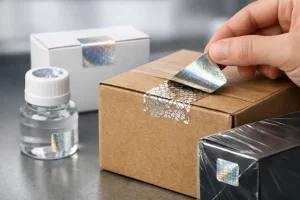
That evidence can appear in different ways. Some labels leave behind a hidden message such as VOID when removed. Others destruct on application and tear into fragments if someone tries to peel them off. Some bridge closures so opening the pack breaks the label. In high-risk applications, holographic or serialized features may be added to strengthen authentication as well as tamper indication.
This matters because packaging failure is not always obvious. A resealed carton, a refilled bottle, or a relabeled product may still look acceptable at first glance. Tamper-evident construction reduces that ambiguity. It gives warehouse teams, retailers, inspectors, and end users a simple visual signal that the original pack condition has changed.
Why the requirement is growing across sectors
The demand for tamper-evident packaging has expanded well beyond pharmaceuticals. Food, beverages, nutraceuticals, personal care, chemicals, lubricants, electronics, and logistics-sensitive goods all face some combination of theft, contamination risk, counterfeiting, product substitution, or unauthorized access.
In regulated categories, the case is straightforward. Packaging must support product safety and traceability, and visible tamper indication helps meet that expectation. In commercial categories, the pressure comes from brand protection and customer trust. If a product reaches the shelf or the customer in questionable condition, the cost is not limited to a single returned unit. It can ripple into retailer friction, damaged brand perception, and avoidable investigation costs.
E-commerce has increased the stakes. Products now pass through more handling points, more transfer environments, and more third-party logistics operations. Every additional touchpoint raises the need for a label that can show whether the package remained intact through transit.
Not every tamper-evident construction works the same way
This is where specification matters. Buyers sometimes treat tamper-evident labels as a generic category, but performance depends heavily on construction, substrate, adhesive, and application environment.
Destructible film labels are useful when label removal itself should be impossible without visible damage. These are common for electronics, warranty seals, and high-value components. Void labels are preferred when leaving a residue or message behind offers a stronger audit trail. Security slit labels can make lifting difficult by causing the label to separate along pre-designed cuts. Seal labels that bridge caps, lids, or carton flaps are often the right fit when the opening event needs to be clearly visible to consumers and inspectors.
The best choice depends on the pack format and the risk profile. A rigid plastic pharmaceutical bottle has different requirements than a corrugated logistics carton. A refrigerated food pack behaves differently from an industrial lubricant container exposed to heat, oil, and rough handling. There is no one-size-fits-all construction, and that is why material selection should be tied to the actual use case rather than a generic security claim.
The technical factors that affect real-world performance
A tamper-evident label only works when it remains stable until the moment tampering occurs. That sounds obvious, but it is where many poor specifications fail.
Surface energy is one of the first variables to consider. Labels behave differently on glass, HDPE, PET, metal, coated board, and textured corrugate. Adhesive selection must match the substrate if the seal is expected to hold through transport, storage, and handling. Temperature also matters. A label applied in a cold filling room, used in a freezer chain, or stored in a hot warehouse may need a very different adhesive system than one used in ambient conditions.
Print durability is another critical factor. If warning text, serial data, or authentication graphics smudge, fade, or detach, the security message weakens. For many industries, the tamper-evident function and the information function sit on the same label. That means facestock, inks, coatings, and print method all need to work together.
Application method should not be overlooked either. A label designed for hand application may not perform the same way on a high-speed automatic line. Corner wrap, cap seal, neck seal, and flap seal formats each place different stresses on the material during dispensing and application. Production efficiency matters, but not at the cost of seal integrity.
Where tamper evident labels add the most value
The strongest use cases are usually the ones where package integrity has operational consequences, not just cosmetic ones.
In pharmaceuticals and healthcare, tamper indication supports patient safety, compliance expectations, and product confidence. In food and beverage, it helps signal product freshness and reduces the risk of consumer concern around opened or altered packs. In personal care and cosmetics, it protects both product presentation and brand credibility in retail environments.
Industrial and automotive products benefit for different reasons. Lubricants, chemicals, and specialty fluids can be vulnerable to dilution, substitution, or unauthorized reuse of containers. A tamper-evident closure label adds a visible checkpoint. In electronics and components, destructible or warranty security labels can discourage unauthorized access and simplify service verification. In logistics, tamper-evident labels on secondary packs or transit cases can support chain-of-custody controls and shrinkage monitoring.
Compliance, brand protection, and operations are connected
Procurement teams may focus on unit economics, operations may focus on application speed, and compliance teams may focus on documented controls. In tamper-evident packaging, these concerns overlap more than they first appear.
A low-cost label that fails under transit stress creates operational waste. A security feature that is too complex for line application slows throughput. A tamper seal that works mechanically but provides weak visual evidence can still create inspection disputes. The best specification is usually the one that balances security visibility, material compatibility, print quality, and production practicality.
That is why enterprise buyers increasingly evaluate tamper-evident labels as part of a larger packaging system. The label has to work with the closure, the container, the distribution environment, and the inspection process. It should also be repeatable at commercial scale. Prototype success means little if the construction cannot hold consistency across large production runs.
How to evaluate a supplier for tamper-evident labeling
This is not a category where generic converting capability is enough. Buyers should look for a manufacturing partner that understands security applications, adhesive behavior, printing precision, and high-volume consistency.
Material recommendation should be based on the end-use environment, not just catalog availability. Trial support should include substrate testing, application assessment, and realistic handling conditions. Print capability matters when the label also carries variable data, branding, barcode content, or overt security elements. Production maturity matters as well, especially when the requirement spans multiple SKUs, pack sizes, or plant locations.
An experienced supplier will also be direct about trade-offs. For example, a more aggressive adhesive may improve permanence but make clean application harder on some surfaces. A highly destructible film may increase security but reduce ease of manual inspection if the label is too small. Security features should be selected for the actual threat, not simply added to make the label look more sophisticated.
For companies managing regulated, high-volume, or high-risk products, that level of precision is not optional. It is part of protecting margins, maintaining compliance, and preserving trust in every sealed pack. Kimoha approaches tamper-evident labeling from that practical manufacturing perspective – where print engineering, material performance, and supply reliability all need to align.
Tamper evidence works best when it feels almost invisible to the operation and unmistakable to anyone who tries to interfere with the package. That is the standard worth specifying.