
 Food
Food Dairy & Poultry
 Beverage
 Home Care
 Beauty & Personal Care
 Health Care & Pharma
 Transport & Logistics
 Automobile
 Aviation
 Retail
 Exhibitions & Events
 Metal
Metal Garment
 Office Supplies
 Consumer Electronics

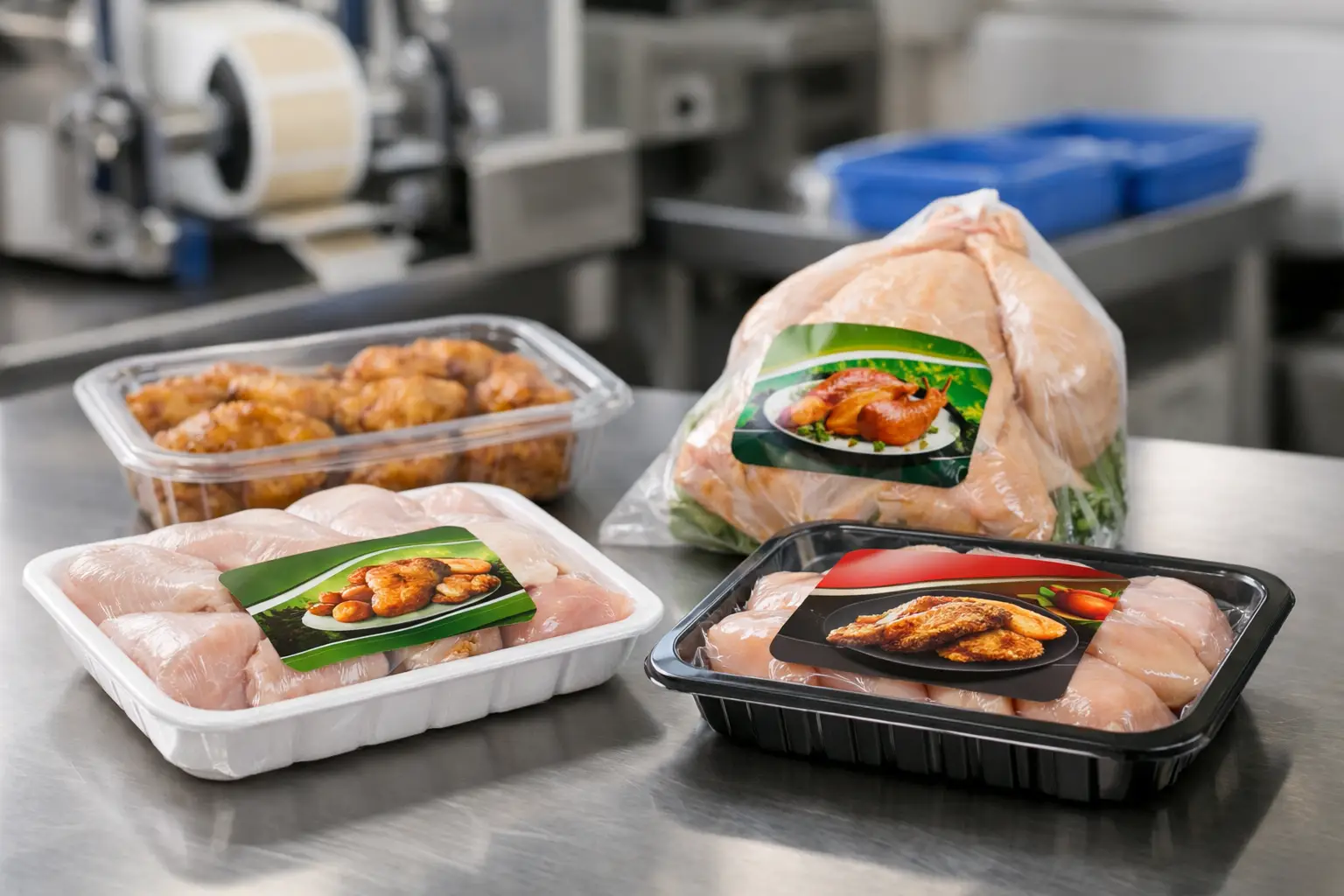
A poultry label fails long before it peels off. It fails when a batch code scans poorly on a wet pack line, when mandatory product data becomes hard to read under condensation, or when the pack reaches retail with branding that looks compromised by cold-chain handling. That is why custom poultry packaging labels are not a finishing detail. They are a production, compliance, and brand-control component that has to perform under pressure.
For poultry processors, brand owners, and packaging teams, the label sits at the intersection of food safety, traceability, logistics, and shelf presentation. It has to carry accurate information, remain legible through chilled or frozen conditions, and apply consistently at speed. A generic label stock or standard print approach often looks acceptable in a sample run but creates avoidable issues in live production. In poultry, those issues tend to surface quickly.
Why custom poultry packaging labels matter
Poultry packaging moves through a demanding environment. Labels may be applied on high-speed lines, exposed to moisture, abrasion, cold storage, freezer conditions, and repeated handling across distribution. At the same time, the package has to communicate product identity, weight, date coding, barcode information, handling instructions, and brand cues with total clarity.
That combination makes customization essential. The right construction depends on the substrate, the pack format, the storage temperature, and the data requirements. A label for fresh chicken trays with overwrap behaves differently from a label for vacuum-packed cuts or frozen bulk packs. Even within the same product range, the label specification may need to change based on line speed, adhesive performance, and print requirements.
For enterprise buyers, the operational value is straightforward. Better label performance reduces rework, scanning failures, relabeling, product holds, and complaints tied to unreadable or damaged information. It also supports a cleaner visual standard at retail, which matters in a category where trust and freshness perception influence purchase decisions.
What custom poultry packaging labels need to deliver
A poultry label has to do more than stick. It needs to maintain adhesion on the chosen packaging surface, whether that surface is film, rigid plastic, corrugate, or another material used in primary or secondary packaging. Adhesive selection is critical here. Moisture, low temperatures, and surface energy all affect performance, and the wrong adhesive can lead to edge lift, tunneling, or failure during transit.
Print clarity matters just as much. Product names, nutritional information, packed-on dates, use-by dates, handling instructions, and barcodes cannot degrade in readability because the pack went from processing to chilled storage. If variable data is part of the workflow, the label face stock and print method must support sharp, durable output under production conditions, not just in lab samples.
There is also the matter of conversion and application. A well-designed label still causes problems if it dispenses poorly, feeds inconsistently, or misaligns on automated applicators. In poultry operations, where line efficiency and output volume are tightly managed, label compatibility with existing equipment is part of performance engineering.
Custom poultry packaging labels for compliance and traceability
In regulated food categories, labels carry operational accountability. Custom poultry packaging labels play a direct role in traceability by supporting batch identification, lot tracking, plant information, and machine-readable coding. When product movement must be tracked quickly across production and distribution, label reliability becomes a supply chain requirement.
This is where customization creates measurable value. Barcode size, contrast, print placement, and material choice all affect scan accuracy. If the label smears, wrinkles, or loses contrast because of cold-chain exposure, downstream logistics and inventory processes become less reliable. The same applies to human-readable information. A label that remains intact and legible under real handling conditions supports faster inspections, cleaner warehouse operations, and better recall readiness if needed.
There is an added brand-protection angle as well. For some poultry applications, tamper-evident features, void materials, or other security-oriented constructions may be justified, especially where supply chains are complex or the packaging format is vulnerable to interference. Not every poultry product needs this level of protection, but for certain channels and export conditions, it is a practical consideration rather than an optional feature.
Material and adhesive choices depend on the use case
No single label construction suits every poultry application. Fresh, chilled, frozen, and export-bound packs create different demands, and the trade-offs are real. A material chosen primarily for premium shelf appearance may not be the best fit for extreme cold or rough distribution. A construction optimized for freezer durability may need refinement if the package also requires strong visual appeal in retail display.
Face stock selection should match both the print objective and the environmental stress. Some applications benefit from filmic materials because of their moisture resistance and dimensional stability. Others may use paper-based constructions where the environment and brand presentation allow it. The decision depends on how long the product remains in cold storage, how much surface moisture is expected, and what data must remain visible through the product lifecycle.
Adhesive behavior is equally application-specific. Chilled environments, condensation, and low-energy packaging films create very different bonding conditions from dry ambient packaging. A technically sound supplier will evaluate not only the final storage condition but also the point of application. Labels applied in one temperature range and stored in another need an adhesive system designed for that transition.
Design still matters in a technical label category
In poultry, packaging is functional first, but that does not make design secondary. Retail packs compete in a crowded refrigerated case, and label design influences visibility, product differentiation, and trust. Clean typography, disciplined information hierarchy, and controlled use of color all help the consumer identify product type, pack size, claims, and preparation cues quickly.
For B2B buyers, the key is balancing visual impact with operational discipline. Overdesigned labels can reduce readability or complicate variable data placement. Underdesigned labels may meet the minimum compliance standard but weaken shelf presence and brand consistency. The strongest packaging programs treat design and technical performance as a shared specification, not separate decisions.
This is also where print capability matters. High-quality flexographic and digital production support different needs across volume, versioning, and artwork complexity. A poultry manufacturer with multiple SKUs, private-label programs, or regional packaging variants may need a solution that combines tight color control with efficient changeovers and consistent repeatability.
Working with the right manufacturing partner
Choosing a label supplier for poultry packaging is less about catalog breadth and more about application understanding. The right partner should be able to discuss substrate compatibility, adhesive performance, print method, coding integration, and line application behavior in practical terms. Sample testing is useful, but production-scale reliability is the real benchmark.
That is especially true for high-volume operations. Minor label issues become major costs when multiplied across shifts, plants, or distribution networks. A manufacturing partner with experience in regulated and logistics-intensive sectors can usually identify risks earlier – before they show up as downtime, rejected packaging, or field complaints.
Kimoha’s approach in this space is built around that kind of precision-led manufacturing logic. For poultry brands and processors, the goal is not simply to produce a label that looks right on day one. It is to deliver a label solution that performs consistently across print, application, cold storage, handling, and traceability workflows.
How to evaluate custom poultry packaging labels before rollout
The smartest label decisions are validated in real conditions. That means checking adhesion after chilled and frozen storage, testing print and barcode readability after exposure to moisture, and confirming dispensing performance on live equipment. A label that passes visual review but fails on the line is not production-ready.
It also helps to evaluate labels against the full packaging journey. Consider where the label is applied, how the product is handled, how often it is scanned, and what information absolutely must remain readable at every stage. In some cases, the right answer is a more durable material. In others, the issue is artwork layout, adhesive selection, or the interaction between the label and the applicator.
The most effective custom poultry packaging labels are not the most complex. They are the ones engineered around the actual realities of poultry processing and distribution. When the label is specified correctly, it supports compliance, protects traceability, strengthens brand presentation, and keeps packaging lines moving with fewer interruptions.
That is the standard worth aiming for – a label that keeps doing its job long after it leaves the printer.