
 Food
Food Dairy & Poultry
 Beverage
 Home Care
 Beauty & Personal Care
 Health Care & Pharma
 Transport & Logistics
 Automobile
 Aviation
 Retail
 Exhibitions & Events
 Metal
Metal Garment
 Office Supplies
 Consumer Electronics

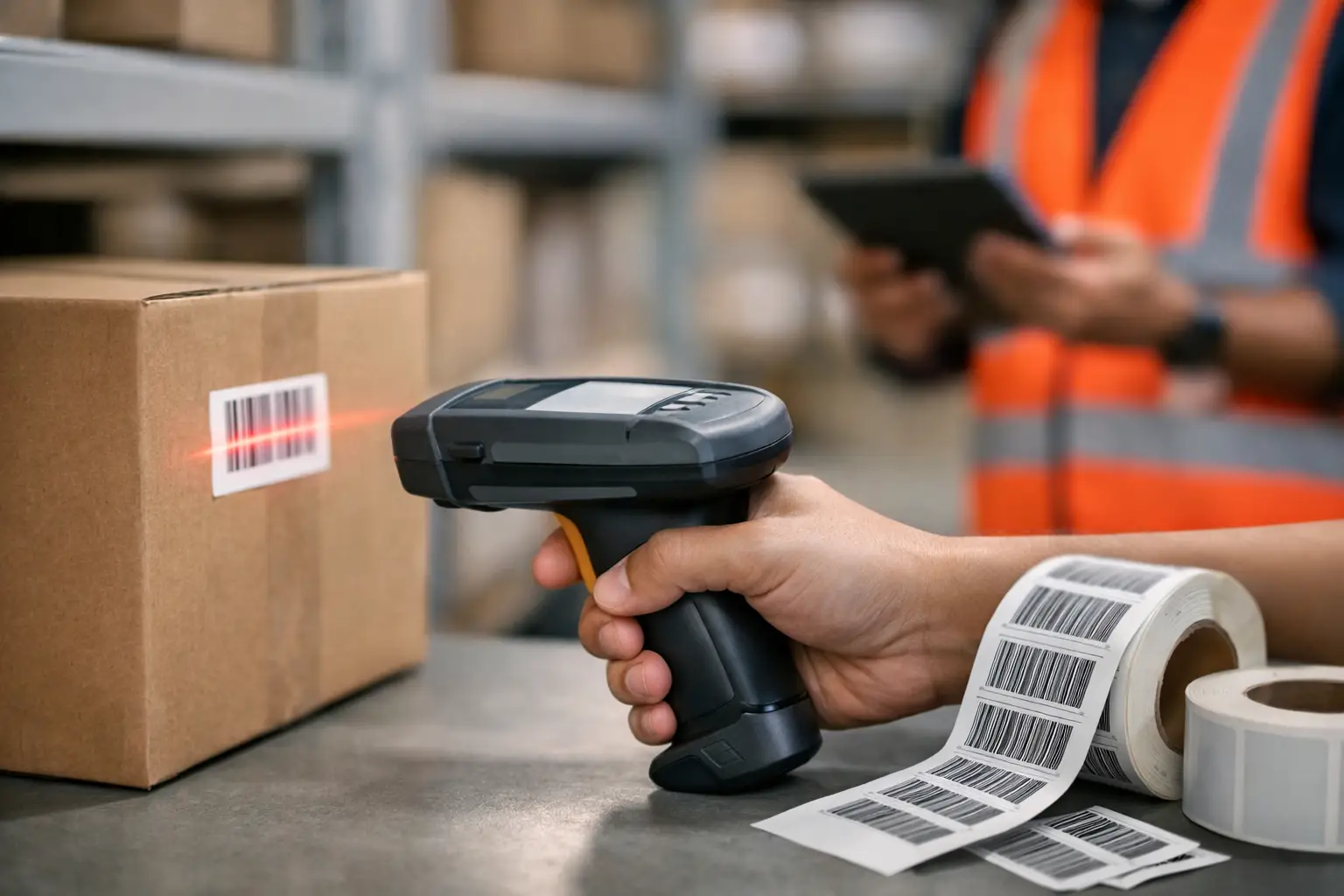
A missing pallet rarely starts as a warehouse crisis. More often, it starts with a label that smudged, peeled, scanned poorly, or failed under the actual conditions of use. That is why barcode labels for inventory tracking are not a minor consumable. They are a control point for accuracy, speed, traceability, and accountability across the supply chain.
For operations leaders, procurement teams, and plant managers, the issue is not whether to use barcodes. It is whether the labels can perform consistently across receiving, storage, picking, packing, dispatch, and returns. When labels fail, systems fail with them. Inventory records drift, exceptions increase, and labor gets pulled into manual correction.
Why barcode labels for inventory tracking matter at the operational level
In high-volume environments, inventory tracking depends on machine-readable information being available at the exact moment it is needed. A barcode label has to survive handling, abrasion, shifting temperatures, moisture, dust, chemicals, and long storage cycles while remaining easy to scan. That sounds simple until the application moves from a controlled office setting to a production line, cold room, freight yard, or export container.
The real value of barcode labels comes from reducing friction. Goods move faster when every unit, carton, tote, bin, and pallet can be identified instantly. Receiving teams can validate inbound stock without manual entry. Warehouse staff can confirm location and movement in real time. Quality and compliance teams gain cleaner records. Finance sees fewer inventory discrepancies. The gains are cumulative, and they compound at scale.
This is also where many companies underestimate label specification. A barcode is only as reliable as the material, adhesive, print quality, and data structure behind it. If any one of those is mismatched to the environment, the label may still look acceptable at dispatch and fail a week later in storage or transit.
What makes a barcode label reliable
A reliable barcode label is engineered for scan performance first, then matched to the operational environment. Print contrast, edge definition, and barcode symbology all affect readability, but so do less visible factors such as face stock stability, adhesive compatibility, and resistance to handling conditions.
For example, a warehouse using standard carton labels in a dry environment has different needs from a dairy facility labeling secondary packaging in cold storage. A pharmaceutical manufacturer may require stronger traceability controls, variable data accuracy, and stricter consistency across batches. An automotive supplier may need labels that remain legible despite oil exposure or heavy handling. In each case, the barcode serves the same basic function, but the label construction should not be the same.
Durability is one part of the equation. Application efficiency is another. Labels must dispense cleanly, apply accurately by hand or machine, and maintain adhesion on the intended surface, whether that surface is corrugated board, plastic film, metal, glass, or uneven packaging. If labels wrinkle, lift, or shift, scanning problems follow.
Choosing the right barcode labels for inventory tracking
Selecting barcode labels for inventory tracking should begin with the use case, not the catalog. Buyers often start with size and printer compatibility, but those are only part of the requirement. The better starting point is to define where the label will be applied, how long it must remain readable, what it will be exposed to, and how it will be scanned.
Surface and substrate matter more than many teams expect
Corrugated cartons, HDPE containers, shrink-wrapped bundles, steel racks, returnable plastic crates, and polybags do not behave the same way. Adhesives that perform well on one surface can underperform on another. Some surfaces have low surface energy. Others may be dusty, cold, textured, or curved. If the label does not bond correctly, barcode quality becomes irrelevant because the label itself will not stay in place.
Environment determines label construction
Temperature swings, condensation, UV exposure, abrasion, and chemical contact all influence material choice. Paper labels may be sufficient for short-cycle indoor use, but they are not always suitable for demanding logistics or industrial applications. Filmic materials often provide better resistance, though the right option depends on the exact environment and required lifespan.
Print technology affects long-term readability
Barcode clarity is not just about printing a code that scans on day one. Thermal transfer, direct thermal, and other print methods behave differently over time. Direct thermal may suit short-duration applications, but it can be vulnerable to heat and fading. For longer shelf life or harsher conditions, a more durable print approach is often the safer option.
Data integrity is as important as physical durability
A perfectly printed label still fails if the wrong data is encoded or variable information is inconsistent across systems. Barcode structure should align with the WMS, ERP, MES, or traceability process in use. The label needs to support not only scanning, but clean data capture across receiving, inventory movement, and fulfillment.
Common failure points in inventory barcode programs
Most barcode issues do not come from the barcode itself. They come from mismatch. A standard label is used in a non-standard environment. An adhesive is chosen for convenience rather than substrate compatibility. Print quality is accepted visually instead of tested for scan grades. Label design is compressed to fit too much information into too little space.
Another common problem is assuming all scanners will perform equally across all codes. Fixed scanners, handheld devices, mobile computers, and automated systems have different tolerances. If inventory tracking involves fast scan workflows or longer scan distances, barcode size and placement need more attention.
There is also a process issue that enterprise buyers know well: departments make isolated decisions. Packaging selects one label format, warehousing uses another, and compliance adds additional data later. The result is a fragmented labeling program that increases complexity instead of reducing it. A stronger approach standardizes where possible and customizes only where the environment truly demands it.
Where custom labels outperform generic supply
Off-the-shelf labels may be adequate for routine, low-risk use. But once operations become more specialized, custom manufacturing provides measurable advantages. This is especially true where traceability supports compliance, product authentication, export logistics, batch control, or demanding storage conditions.
A custom barcode label can be engineered around exact dimensions, scanner requirements, adhesive behavior, surface compatibility, and print method. It can also incorporate variable data, serialization, color coding, tamper evidence, or brand-specific identification elements when the application requires more than basic stock control.
That matters in sectors where inventory is tied directly to regulatory accountability or production continuity. In pharmaceuticals, food processing, aviation, electronics, and industrial manufacturing, a barcode label is often part of a larger control system. The label does not just identify stock. It supports recall readiness, batch traceability, maintenance records, or product integrity.
For that reason, experienced label manufacturers bring value beyond print. They help define construction, test performance, and align the label with the workflow it must support. For enterprises managing multiple SKUs, facilities, or export channels, that technical guidance can prevent expensive relabeling, scanning exceptions, and process disruption later.
How to evaluate label performance before rollout
A barcode labeling program should be validated in real conditions, not approved from a sample sheet alone. Lab suitability and field performance are not always the same. The right evaluation includes trial application on actual substrates, storage under expected conditions, and scan testing through the devices and software used in operation.
It is also worth checking the full life cycle. A label may scan well when freshly applied but degrade after transit, refrigeration, or repeated handling. For long dwell inventory, this becomes critical. If labels must remain readable for weeks or months, the test period should reflect that reality.
Consistency across production runs also matters. Enterprise buyers should look for suppliers with established manufacturing controls, print precision, and the ability to maintain quality at volume. A barcode specification that works on a pilot batch but drifts at scale is not a reliable solution.
Kimoha’s approach in this space reflects what serious inventory environments require: precision-engineered label construction, scalable production, and application-specific performance rather than generic supply.
Barcode labels as part of a broader traceability system
Inventory tracking rarely exists in isolation. Barcode labels often connect to shipping labels, product labels, pallet IDs, warehouse locations, and in some operations, RFID or security features. That broader view matters because the best results come when labeling is treated as infrastructure rather than packaging afterthought.
For example, a manufacturer may use barcode labels for raw material control, work-in-progress tracking, finished goods storage, and dispatch verification. If each stage uses inconsistent label specifications, scanning reliability suffers and data capture becomes fragmented. A coordinated label strategy creates continuity from production to delivery.
This does not mean every application should use the most durable construction available. Over-specification can be wasteful, just as under-specification can be risky. The better decision is fit-for-purpose engineering. Short-cycle carton movement may need one label format. Export pallets, chemical exposure, or cold-chain handling may need another.
The strongest barcode programs balance standardization with operational realism. They are designed around scan performance, environmental resistance, application method, and system integration – not just unit consumption.
If inventory accuracy matters to your business, the label deserves the same technical attention as the scanner, the software, and the workflow. Small failures at the label level have a way of becoming large operational problems later. Getting the specification right early is usually the quieter, smarter decision.