 Food
Food Dairy & Poultry
 Beverage
 Home Care
 Beauty & Personal Care
 Health Care & Pharma
 Transport & Logistics
 Automobile
 Aviation
 Retail
 Exhibitions & Events
 Metal
Metal Garment
 Office Supplies
 Consumer Electronics

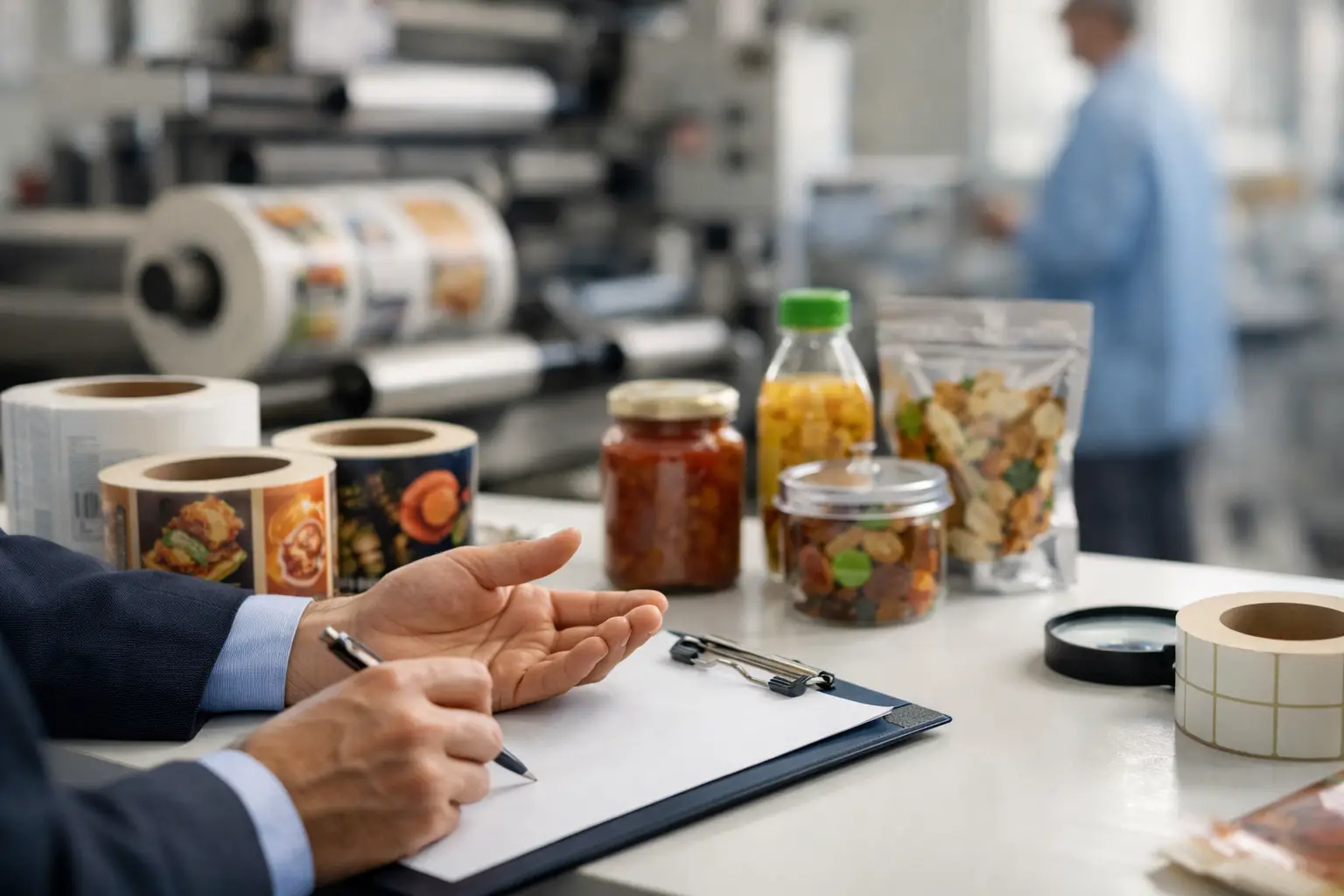
A missed scan at receiving, a label that lifts in cold storage, or a print run that shifts color between batches can create problems far beyond packaging appearance. For food brands and processors, the right food packaging label manufacturer affects compliance, traceability, line efficiency, product integrity, and shelf performance at the same time. That is why label sourcing should be treated as an operational decision, not a routine print purchase.
What a food packaging label manufacturer actually delivers
A capable food packaging label manufacturer does more than print artwork on adhesive stock. The job includes matching facestock, adhesive, liner, print method, finish, and label construction to the product’s real operating conditions. Those conditions may include refrigeration, freezer storage, moisture, oil exposure, abrasion during transit, or high-speed automated application.
In food manufacturing, labels carry multiple responsibilities. They communicate brand identity on the shelf, support legal and retailer compliance, and enable traceability across production and distribution. If any one of those functions fails, the impact can move quickly from a packaging issue to a supply chain issue.
That is why experienced manufacturers evaluate labels by use case, not by appearance alone. A sauce bottle, a dairy cup, a vacuum-packed meat product, and a dry snack pouch may all need very different materials and print approaches, even when the graphic requirements look similar on screen.
Why food labeling is less forgiving than many other categories
Food packaging environments are demanding because the label has to remain stable from production through consumption. A label may be applied in a humid plant, pass through chilled warehousing, face condensation at retail, and still need to stay legible in the consumer’s refrigerator. In some categories, oils, spills, or repeated handling add further stress.
At the same time, food labels are expected to carry precise information. Ingredient declarations, nutrition panels, batch details, manufacturing dates, barcode elements, storage instructions, and branding all compete for space. Small print errors or poor registration are not minor defects when readability and scan accuracy matter.
There is also a timing issue. Food operations usually run on strict schedules, and packaging interruptions can cascade quickly. If labels are inconsistent in dimension, adhesive behavior, or roll quality, they can reduce line speed or increase rework. Procurement teams may focus on supply continuity, but operations teams know that consistency on the reel is just as important as consistency on the invoice.
How to evaluate a food packaging label manufacturer
The best evaluation process starts with the production environment, not the sample book. Buyers should ask how the manufacturer approaches application conditions, substrate compatibility, and regulatory labeling requirements for food products. A manufacturer with real category experience will ask detailed questions before recommending a construction.
Material selection matters more than many buyers expect
The wrong facestock or adhesive can fail even when print quality looks excellent. For chilled and frozen applications, adhesion performance under low temperatures is critical. For oily or moist surfaces, the label has to maintain bond strength without edge lift. For flexible packaging, conformability may matter more than stiffness. For products exposed to rough distribution handling, surface durability and scuff resistance become central.
This is where technical depth separates commodity supply from engineered labeling. A manufacturer should be able to explain why a certain construction suits a particular package type and what trade-offs come with that choice. A highly aggressive adhesive may improve initial tack but create issues on some substrates. A premium finish may improve shelf appearance but affect writeability or overprint compatibility. The right answer depends on the product, the package, and the process.
Print capability should support both branding and control
Food labels are rarely just decorative. They need reliable color reproduction for brand consistency, but they also need clear text, accurate variable data, and dependable barcode performance. Manufacturers with both flexographic and digital capability can often offer more control across volume ranges, versioning needs, and artwork complexity.
For long production runs, efficiency and repeatability are major advantages. For shorter runs, seasonal SKUs, multilingual packaging, or frequent design changes, digital flexibility can reduce operational friction. Neither method is universally better. The right manufacturing partner understands where each process delivers stronger business value.
Compliance readiness cannot be an afterthought
A food packaging label manufacturer should understand that compliance is built into production discipline. That includes print accuracy, version control, material suitability, and the ability to maintain quality across repeat orders. In regulated environments, a visually acceptable label is not enough if the content, code, or batch detail is inconsistent.
This is especially relevant for brands managing multiple product variants, export markets, or retailer-specific requirements. Label errors at that level can disrupt distribution, trigger relabeling, or compromise traceability. A capable manufacturer should have controls that reduce those risks rather than shifting them downstream.
The operational signals of a strong manufacturing partner
In B2B label procurement, capability is not measured only by a polished sample reel. It shows up in process stability, technical consultation, and the ability to scale without quality drift. A strong manufacturer will speak clearly about tolerances, application requirements, and print consistency because those details affect packaging line performance.
One useful sign is whether the manufacturer thinks beyond the label itself. If a supplier asks about applicator speed, container material, storage conditions, ribbon compatibility, variable printing needs, or transport exposure, that is usually a good indicator of practical manufacturing knowledge. The label has to work in the system around it.
Another signal is production range. Manufacturers serving fast-moving and technically demanding sectors often have stronger discipline around repeatability, inspection, and material control. That matters in food because reliability is rarely about one perfect batch. It is about getting the same performance across every order, every shift, and every distribution cycle.
Where food brands often get label sourcing wrong
A common mistake is approving a label based on appearance under office conditions. A label can look sharp on a desk and still fail in a refrigerated supply chain. Another mistake is treating all adhesives as interchangeable. They are not. Surface energy, moisture, temperature, and application timing all affect performance.
Some brands also separate design approval from application testing. That creates risk. Shelf appeal matters, but so do dispense performance, scan reliability, and durability after filling, packing, and transit. The more demanding the environment, the more important it is to validate the label in real use conditions.
There is also a tendency to underestimate version complexity. Food businesses with multiple SKUs, languages, private label formats, or region-specific compliance text need tighter artwork and production control. A manufacturer that can manage this complexity with precision helps reduce downstream errors that are expensive to correct once packaging is in motion.
Why scale and specialization both matter
Food businesses need manufacturing partners that can support volume, but scale alone is not enough. A high-capacity supplier without application knowledge may still create avoidable performance problems. The better choice is usually a manufacturer with both production depth and category-specific understanding.
That is where industrial label specialists tend to stand out. Companies such as Kimoha, with established experience across packaging, traceability, and high-performance label applications, bring a more engineered approach to food labeling. That matters when the label must support brand presentation, compliance, and operational efficiency without compromise.
Specialization also becomes more valuable as packaging formats diversify. Brands now work across jars, pouches, trays, cartons, sleeves, promotional variants, and logistics labels within the same product ecosystem. The manufacturer needs to think across that full chain, not just the front label.
What the right decision looks like
Choosing the right food packaging label manufacturer means finding a partner that can translate packaging demands into dependable label performance. The strongest manufacturers combine print precision with material knowledge, process control, and a clear understanding of how labels behave in food production and distribution environments.
For procurement, that reduces supplier risk. For operations, it protects line performance. For compliance teams, it supports consistency and traceability. For brand teams, it preserves shelf impact without sacrificing function. Those outcomes are connected, and the label sits at the center of all of them.
If your packaging line, retail presence, and traceability requirements all depend on the same small piece of printed material, it makes sense to choose a manufacturer that treats that responsibility with engineering discipline rather than basic print execution.