 Food
Food Dairy & Poultry
 Beverage
 Home Care
 Beauty & Personal Care
 Health Care & Pharma
 Transport & Logistics
 Automobile
 Aviation
 Retail
 Exhibitions & Events
 Metal
Metal Garment
 Office Supplies
 Consumer Electronics

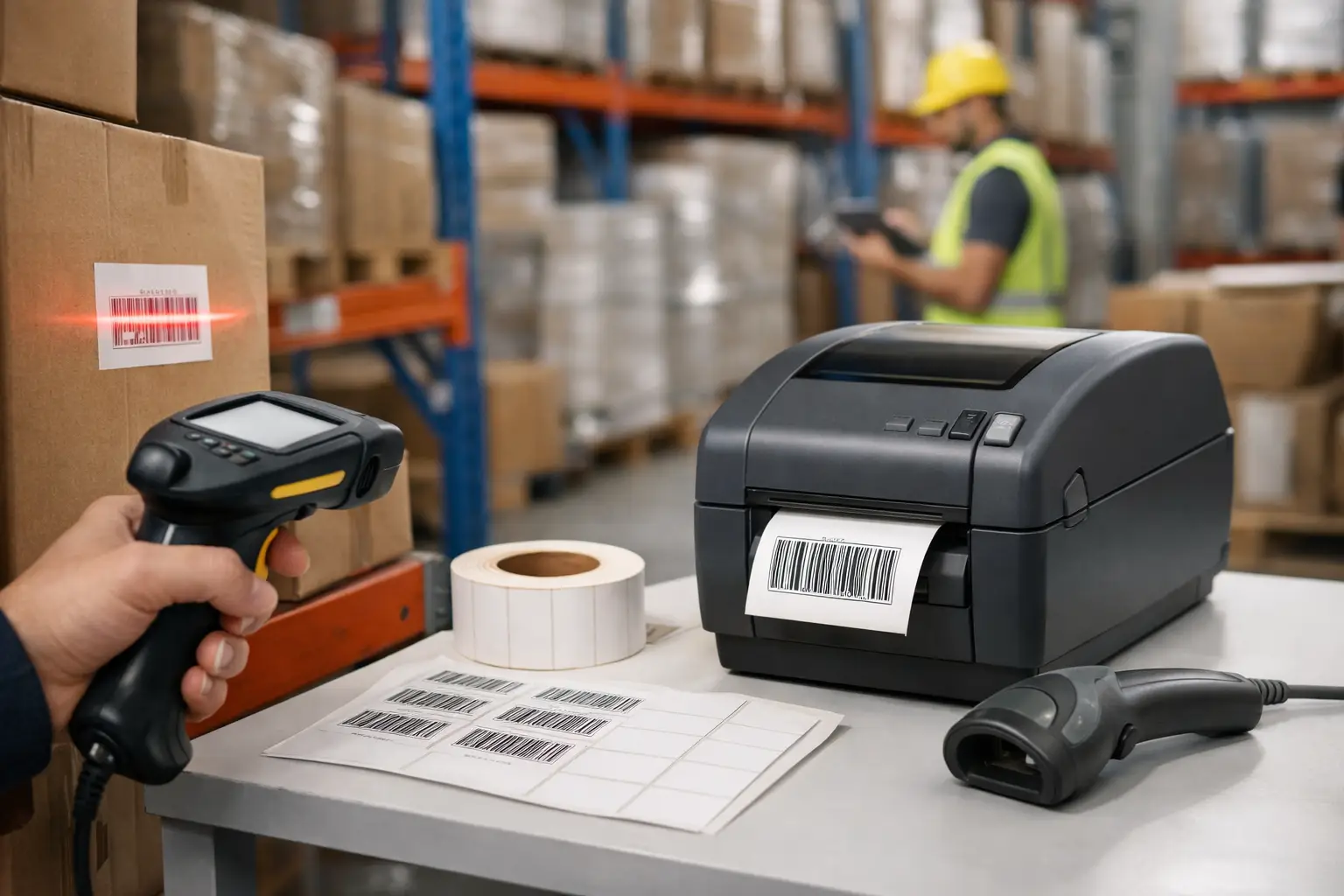
A missed scan at receiving can ripple through the entire warehouse by noon. Inventory counts drift, replenishment gets delayed, and teams start solving avoidable problems by hand. That is why warehouse barcode label solutions are not a minor consumable decision. They are part of the operating system of a high-volume facility.
In most warehouses, label performance is judged only after something fails. A barcode curls on a cold surface, the print fades in abrasion-heavy zones, or the adhesive lifts from corrugated cartons before the product reaches dispatch. By then, the cost is already visible in labor time, rework, chargebacks, and poor inventory confidence. The better approach is to specify barcode labels as an engineered component of warehouse operations, not as generic printed stock.
What warehouse barcode label solutions need to solve
A warehouse label has one job on paper, but several jobs in practice. It must carry accurate data, scan quickly, stay attached through handling, and remain legible across the full movement of goods. That sounds straightforward until the environment changes from inbound pallets to freezer storage to outbound shipping lanes.
The challenge is that warehouses are mixed-condition environments. One label may be applied to shrink wrap, another to corrugated packaging, another to plastic bins or metal racks. Some are scanned once, while others are scanned dozens of times over weeks or months. The right solution depends on substrate, dwell time, scan distance, environmental stress, and how the barcode fits into the warehouse management workflow.
This is where many operations teams run into preventable friction. A label spec that works for case identification may fail for location labeling. A direct thermal label may be acceptable for short-cycle shipping, but not for long-term storage where heat, rubbing, and moisture can degrade print quality. Material selection, adhesive choice, and print method all affect scan reliability.
The core elements of effective warehouse barcode label solutions
Barcode performance starts with print quality, but it does not end there. The scanner reads contrast, edge definition, quiet zones, and placement consistency. If the print is sharp but the label wrinkles on application, scan rates still suffer. If the adhesive is strong but the face stock tears during handling, the barcode becomes unreadable.
A well-designed warehouse barcode label solution brings together four technical factors. The first is face material, which determines durability, flexibility, and print compatibility. Paper labels may work well for short-term logistics use, while filmic materials are better suited for moisture, abrasion, and extended service life.
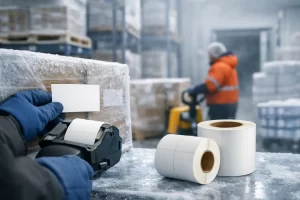
The second factor is adhesive. Permanent adhesives are common, but not all permanent adhesives behave the same way across corrugated board, stretch wrap, drums, totes, or racking. In cold-chain and variable-temperature operations, adhesion has to be matched to both application temperature and service temperature. A label that bonds well in ambient conditions may fail if applied in a chilled zone.
The third factor is print technology. Thermal transfer is often preferred where durability matters because ribbon-based printing resists fading and smudging better than direct thermal in many warehouse settings. Direct thermal still has a place, especially for fast-moving labels with limited lifespan, but it is not the default answer for every operation.
The fourth factor is barcode design itself. Symbology, size, density, orientation, and human-readable information must be aligned with the scanning hardware and use case. Smaller is not always better. Dense barcodes may save space, but they can reduce scan reliability if printers, scanners, or application surfaces are not optimized.
Matching labels to warehouse use cases
Not every warehouse barcode label solution should be built to the same spec. That is where experienced manufacturing support matters. Receiving labels, pallet labels, bin labels, rack labels, and shipping labels each operate under different conditions.
Pallet labels usually need high first-pass scan rates from multiple angles and distances. They are often exposed to abrasion from movement, stretch wrap contact, and repeated handling by forklifts and warehouse teams. A label for this application should prioritize print clarity, strong tack, and sufficient face durability.
Location labels on racks and shelves present a different challenge. These labels may remain in place for long periods and face dust, warehouse traffic, cleaning chemicals, or sunlight near loading areas. In these cases, the concern is less about short-term logistics and more about long-term readability and substrate compatibility.
Shipping labels often have shorter service life, but they still need to survive rough handling, conveyor movement, and transport conditions. If the outbound process includes cross-docking or carrier handoffs, scan consistency becomes critical beyond the warehouse itself.
For reusable bins, totes, and returnable transport items, label construction becomes more specialized. Some operations need labels that stay put through repeated cycles. Others need clean removability without residue. The right answer depends on whether traceability is tied to a permanent asset or a temporary load.
Why material and adhesive selection matter more than many buyers expect
Warehouse teams often notice barcode quality first because it is visible. Adhesive chemistry is less visible, but it has just as much operational impact. A barcode that scans perfectly on day one is still a failed label if it lifts, tunnels, or edge-peels before the inventory cycle is complete.
Corrugated packaging is a good example. Its surface texture can vary widely, especially in high-volume supply chains. Recycled content, dust, and compressed fibers can all affect adhesion. Plastic surfaces introduce a different set of variables, including low surface energy and condensation. Metal and powder-coated surfaces may require even more careful matching.
This is why warehouse barcode label solutions should be tested against real substrates and actual operating conditions. Lab assumptions are useful, but field conditions reveal the real constraints. If labels are applied at high speed by hand or applicator, that process also needs to be accounted for. The best label on paper can still underperform if the application method creates wrinkles, air pockets, or inconsistent pressure.
Durability, compliance, and traceability are connected
For many sectors, barcode labels are not only about speed. They also support auditability, product control, and traceability. In regulated or high-risk industries, a failed label can do more than slow operations. It can compromise lot tracking, returns handling, or proof of movement through the supply chain.
That is especially relevant in food, pharmaceutical, electronics, automotive, aviation, and other sectors where warehouse identification needs to remain accurate across storage and dispatch stages. If the barcode carries lot numbers, serial data, or internal control information, print permanence and scan reliability become part of risk management.
In enterprise environments, barcode labels also have to fit broader systems. Warehouse management software, ERP integration, handheld scanners, mobile printers, and automated identification workflows all depend on consistent label behavior. The label cannot be treated as a disconnected item. It has to perform as part of a wider traceability architecture.
How to evaluate a label supplier for warehouse applications
The right supplier should be able to discuss more than dimensions and artwork. They should understand scan environments, substrate behavior, adhesive performance, and print compatibility at production scale. That includes knowing when a standard spec is enough and when a custom construction is justified.
Manufacturing capability matters here. Warehouses rarely operate with static demand, and label programs often need consistent quality across large volumes, multiple SKUs, and changing operational conditions. A supplier with strong flexographic and digital printing capability can support both scale and variation, which is useful when operations require serialized information, multiple formats, or specialized material combinations.
It also helps to work with a partner that understands sector-specific demands. A food distribution warehouse does not have the same labeling pressures as an aviation parts facility or a pharmaceutical storage operation. Application knowledge reduces trial-and-error and leads to faster specification decisions.
Kimoha approaches this category as an industrial labeling requirement, not a generic print job. That distinction matters because warehouse labels are expected to deliver measurable performance, not just acceptable appearance.
A better way to think about warehouse barcode labels
Warehouse barcode label solutions work best when they are specified from the floor backward. Start with where the label will be applied, what it will stick to, how long it must last, how often it will be scanned, and what can go wrong if it fails. That process usually leads to a better material and print decision than choosing based on familiarity alone.
There is no single best warehouse barcode label for every operation. A high-volume ambient warehouse, a cold-chain facility, and a multi-site distribution network will each have different priorities. The practical advantage comes from selecting labels with the same discipline used for any other operational input – based on performance, compatibility, and reliability over time.
When labels scan correctly, stay attached, and support traceable movement without intervention, the warehouse runs quieter. That is often the strongest sign that the solution was specified well.