 Food
Food Dairy & Poultry
 Beverage
 Home Care
 Beauty & Personal Care
 Health Care & Pharma
 Transport & Logistics
 Automobile
 Aviation
 Retail
 Exhibitions & Events
 Metal
Metal Garment
 Office Supplies
 Consumer Electronics

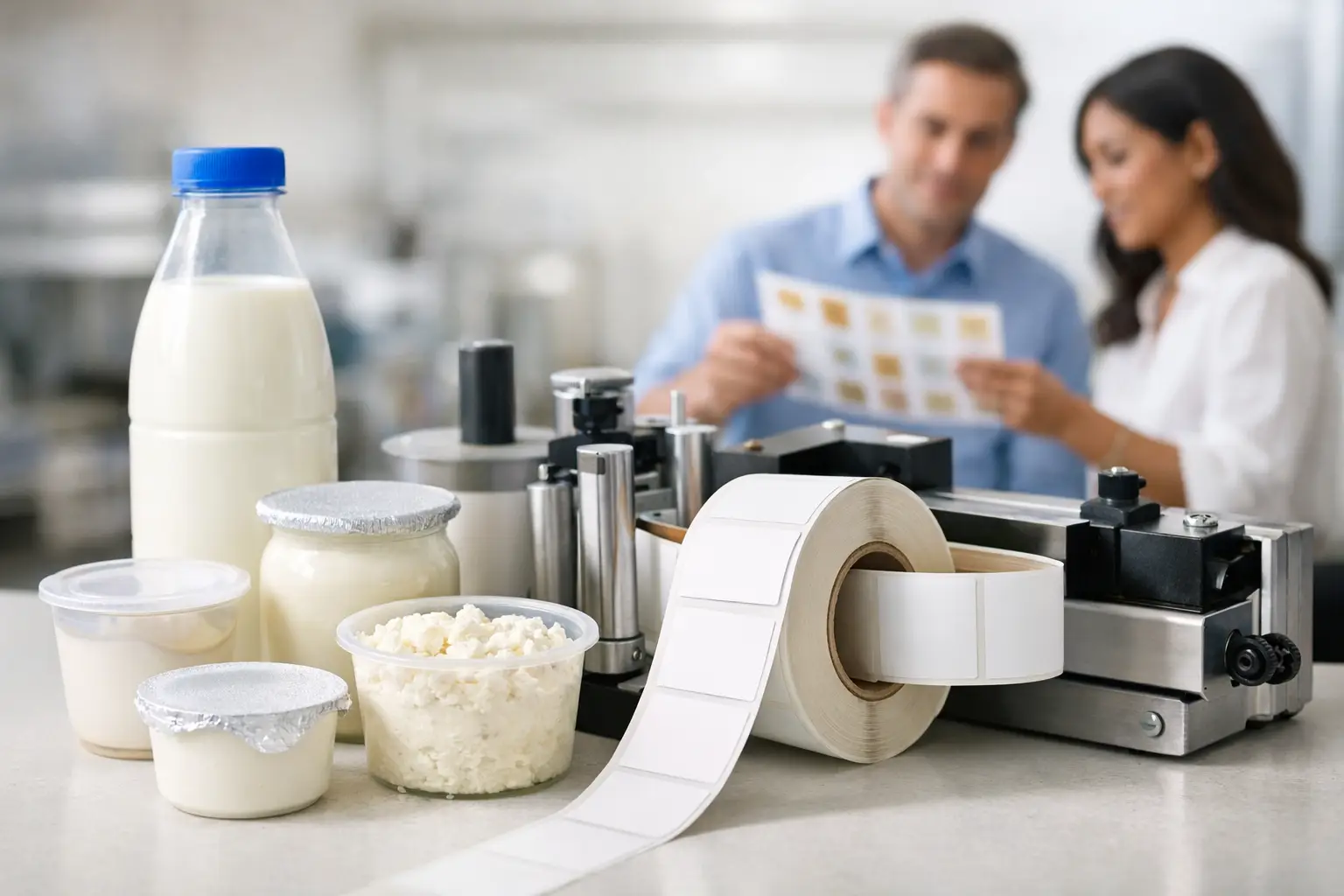
Milk bottles sweating in a chilled truck, yogurt cups moving at line speed, butter packs stacked in secondary cartons – dairy packaging puts labels under pressure. That is why choosing the right dairy product labels supplier is not a routine procurement decision. It directly affects shelf appeal, traceability, compliance, and production continuity.
In dairy, labels do more than identify a product. They must stay legible in cold storage, resist moisture, handle abrasion during transport, and support variable information such as batch numbers, dates, and barcodes. For brands operating at scale, a label failure is rarely isolated. It can slow filling lines, create scanning issues in distribution, or weaken consumer confidence at the point of sale.
What a dairy product labels supplier is really expected to deliver
A capable dairy product labels supplier is not only printing artwork accurately. The supplier is expected to understand the packaging substrate, the filling environment, the storage conditions, and the regulatory demands attached to dairy categories. That includes milk, curd, cheese, butter, ghee, yogurt, flavored dairy drinks, and frozen or chilled dairy desserts.
Each format creates a different technical challenge. A label for a rigid HDPE milk bottle behaves differently from one applied to a PET beverage container or a laminated lidding film. The adhesive, face stock, print process, and finish all need to match the actual use case. A label that looks excellent on the approval sheet can still fail on a wet production floor if materials are selected without enough operational context.
For enterprise buyers, this is the difference between a print vendor and a manufacturing partner. The right supplier aligns label construction with line efficiency, warehouse handling, and retail presentation rather than treating labels as a commodity input.
Why dairy labeling is technically demanding
Dairy is a high-volume category with narrow tolerance for inconsistency. Products often move quickly from filling to cold storage to transport, and that compressed cycle exposes labels to condensation, low temperatures, and surface contamination. If the package is filled in a humid environment or stored in refrigeration immediately after application, adhesive performance becomes critical.
Print durability matters just as much. Date codes, batch details, and barcode clarity must remain readable throughout the supply chain. Smudging, fading, or poor adhesion can create downstream issues in inventory control and retail scanning. When products are distributed across multiple markets, label consistency also supports audit readiness and brand control.
There is also a visual trade-off to manage. Dairy is highly competitive at shelf level, so packaging needs strong print quality and brand presence. At the same time, operations teams need labels that run cleanly on applicators, maintain release performance, and minimize stoppages. The best supplier can support both sides without compromising either.
Key capabilities to look for in a dairy product labels supplier
Material compatibility should be one of the first evaluation points. Dairy packaging may involve plastic bottles, tubs, glass containers, pouches, wraps, cartons, and sleeves. A supplier should be able to recommend constructions based on the container surface, expected temperature range, and exposure to water or oil. This is especially relevant for products such as butter, cheese, and cultured dairy, where handling conditions vary widely.
Adhesive selection is equally important. Permanent adhesives may be required for cold and wet conditions, while specialized options may be needed for squeezable containers, curved surfaces, or applications where condensation develops quickly. There is no single adhesive that suits every dairy line. The right choice depends on the product format and how the package behaves after filling.
Print technology matters when brands manage multiple SKUs, regional variants, or short production runs alongside core high-volume lines. Flexographic printing is effective for scale and repeat consistency, while digital capabilities can support versioning, promotional changes, or variable print requirements. A supplier with both capabilities can respond more effectively to shifting production needs.
Finishing quality should not be overlooked. Precise die-cutting, stable liner performance, and consistent roll winding all influence application efficiency. Many label issues that appear to be machine problems are actually supply issues rooted in poor conversion discipline.
Compliance is not a side issue
For dairy manufacturers, compliance is built into the label. Ingredient declarations, nutritional information, allergen statements, storage instructions, manufacturing details, and traceability data all need to appear clearly and consistently. If a product is exported, the complexity increases with market-specific formatting, language requirements, and barcode standards.
A dependable supplier should understand that compliance is not only about printing mandated text. It is about maintaining repeatable print registration, legibility, and data accuracy across large volumes. Even small deviations can create problems during inspections, recalls, or retailer checks.
This is where process control becomes valuable. Artwork governance, color consistency, version management, and proofing discipline reduce the risk of costly labeling errors. For regulated categories and large portfolios, these controls are not optional. They protect both operational continuity and brand reputation.
Durability in cold-chain and high-moisture environments
Cold-chain performance is one of the clearest tests of label quality in dairy. Labels may be applied in ambient conditions and then moved immediately into chilled storage, or they may be dispensed in cool, damp production zones. In both cases, the label must bond quickly and remain stable over time.
Moisture resistance is only one part of the equation. Labels also need to tolerate friction during packing and transport, especially in crates, corrugated cases, and palletized movement. If the printed surface scuffs too easily, branding suffers and variable data can become unreadable.
This is why application testing matters. A supplier should be prepared to evaluate labels under real production and storage conditions, not only under ideal laboratory assumptions. What works on a sample container for 24 hours may not perform the same way after refrigerated distribution and retail handling.
The value of scalability and supply reliability
Dairy production is time-sensitive. Delays in label supply can disrupt scheduling, increase packaging line downtime, and complicate dispatch planning. For that reason, a dairy label program should be assessed not only for print quality but also for manufacturing reliability, inventory planning, and repeatability.
A supplier serving high-volume sectors should be equipped for consistent production output, controlled quality checks, and dependable dispatch schedules. This becomes even more relevant when a brand operates multiple plants or has a wide product range with frequent replenishment cycles.
Established manufacturers bring an advantage here because process maturity often shows up in fewer avoidable errors. Kimoha, with manufacturing experience dating back to 1988, reflects the type of operational depth that large buyers typically look for when labeling performance affects daily throughput.
Questions procurement and operations teams should ask
When evaluating a supplier, the most useful questions are practical ones. Ask how they match label materials to chilled and wet-use environments. Ask what print technologies they use for high-volume consistency and SKU variation. Ask how they control roll quality, color repeatability, and version accuracy. And ask whether they can support barcode, RFID, tamper-evident, or security features if the product line requires stronger traceability or brand protection.
It is also worth understanding how the supplier handles change. Dairy packaging evolves often because of retailer requirements, compliance updates, seasonal campaigns, and line expansion. A supplier that can adapt without disrupting quality gives procurement and packaging teams more control over future shifts.
Choosing for performance, not just supply
The strongest dairy labeling programs are built around fit-for-purpose engineering. That means selecting a supplier who understands how labels behave on actual dairy packs, in actual production conditions, across actual distribution channels. Good print is expected. What matters more is whether the label continues to perform after filling, cooling, packing, transport, and retail handling.
A dairy product labels supplier should help reduce risk, not add to it. That includes supporting consistent application, preserving print clarity, meeting compliance needs, and protecting brand presence under cold-chain stress. When those requirements are treated as part of one system rather than separate tasks, labels stop being a weak point in the packaging process.
For dairy manufacturers and brand owners, the better decision is rarely the most generic one. It is the supplier that can translate category-specific demands into repeatable labeling performance, batch after batch, line after line.