 Food
Food Dairy & Poultry
 Beverage
 Home Care
 Beauty & Personal Care
 Health Care & Pharma
 Transport & Logistics
 Automobile
 Aviation
 Retail
 Exhibitions & Events
 Metal
Metal Garment
 Office Supplies
 Consumer Electronics

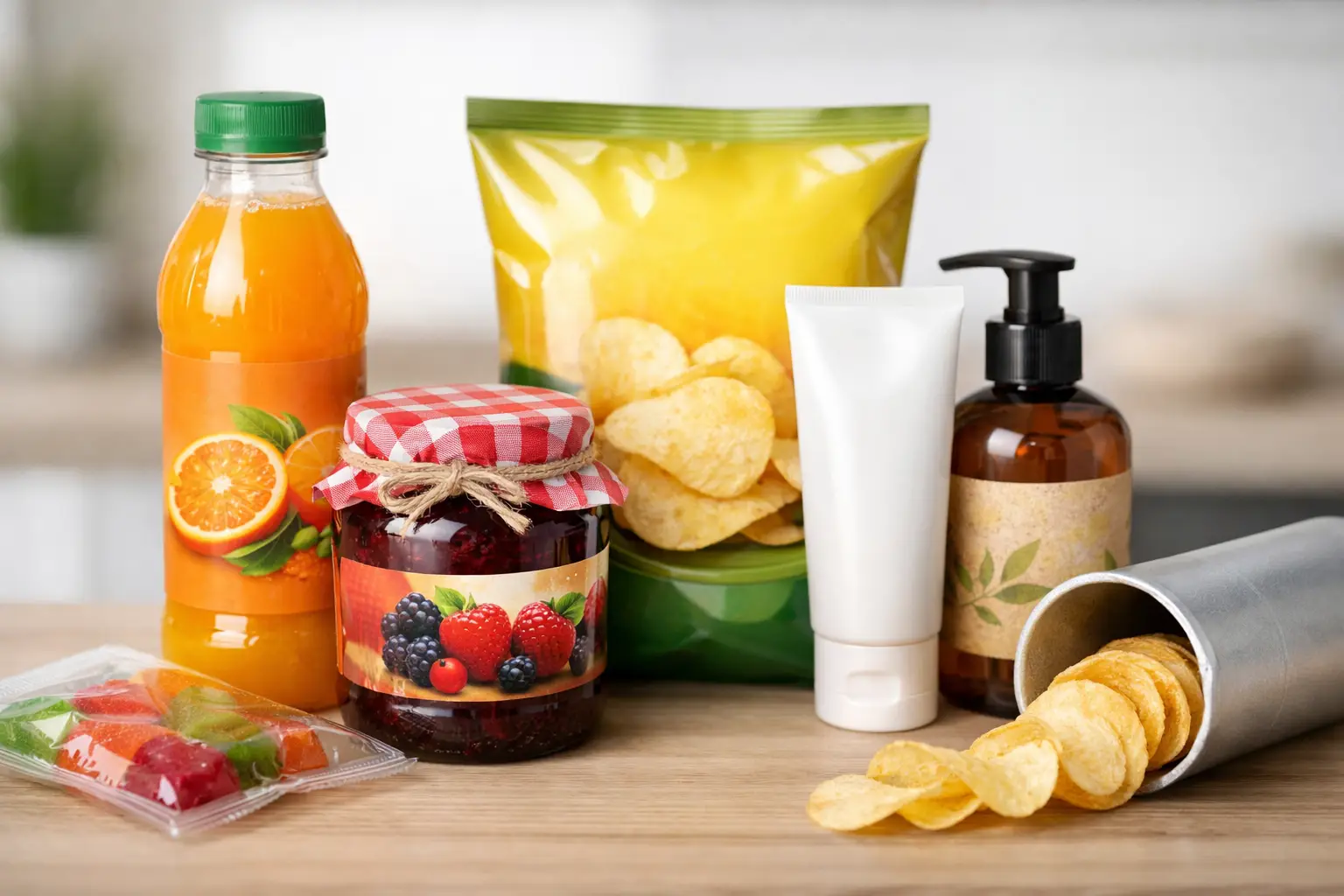
A label failure in FMCG rarely stays small. One scuffed barcode can slow dispatch. One adhesive mismatch can cause edge lift in retail. One poorly selected finish can reduce shelf impact at the exact point where purchase decisions happen. That is why choosing the best packaging labels for FMCG is not simply a design decision – it is a packaging, operations, compliance, and brand performance decision.
FMCG environments put labels under constant pressure. Products move fast through filling lines, warehouses, distributors, and retail shelves. They may face moisture, refrigeration, oil exposure, frequent handling, and aggressive transportation cycles. At the same time, the label still has to do several jobs at once: present the brand clearly, carry mandatory product information, support barcode readability, and stay intact through the entire product journey.
What makes the best packaging labels for FMCG?
The best packaging labels for FMCG are the ones that match the product, the pack surface, the distribution environment, and the application speed. There is no single label structure that works for every SKU. A shampoo bottle, a dairy cup, a snack pouch, and a household cleaner all behave differently on the line and on the shelf.
For enterprise buyers, the right benchmark is performance consistency at scale. That means stable adhesion, print clarity, converting precision, and material compatibility with high-volume dispensing systems. A label that looks acceptable in a sample run but fails in mass application is not a suitable FMCG solution.
This is where technical specification matters more than broad category claims. Face stock selection, adhesive chemistry, release liner behavior, print process, embellishment requirements, and overlamination all influence how the label performs in production and in-market. The strongest FMCG label programs are usually built around end-use conditions, not around aesthetics alone.
Pressure-sensitive labels remain the core FMCG choice
For a large share of consumer packaged goods, pressure-sensitive labels are still the most practical and scalable option. They support high-speed application, strong print quality, and flexibility across pack formats. They also work well when brands need multiple SKU variations, regional versions, or frequent promotional changes.
Their strength lies in balance. Pressure-sensitive constructions can deliver strong shelf presentation while maintaining barcode legibility, ingredient disclosure, and batch-level traceability. They are especially effective for bottles, jars, containers, and certain flexible packaging formats where controlled application and clean finish are essential.
That said, pressure-sensitive labels are not automatically the best choice for every FMCG product. Curved surfaces, condensation-heavy environments, and squeezable containers require careful material and adhesive matching. In those cases, label selection should be validated against actual handling and storage conditions rather than assumed from pack appearance.
Shrink sleeves are strong when branding takes priority
If shelf visibility is central to the packaging strategy, shrink sleeves can be one of the best packaging labels for FMCG lines that rely on high visual differentiation. They provide near full-body decoration, support complex container shapes, and create a premium branded appearance that is difficult to achieve with standard panel labels.
Shrink sleeves are especially effective in crowded categories where product recognition depends on strong color blocking, high graphic area, and 360-degree communication space. Beverage, personal care, and household products often benefit from this format because the package itself becomes a branding surface.
Still, shrink sleeves come with production considerations. Shrink behavior must align with container geometry. Artwork distortion has to be managed carefully. Application and heat tunnel performance must remain stable at commercial speeds. If these factors are not controlled well, appearance issues can offset the branding advantage.
Self-adhesive labels work well for speed and SKU flexibility
In FMCG manufacturing, product portfolios change often. Seasonal variants, compliance revisions, export labeling requirements, and retail-specific packs all create frequent artwork and data changes. Self-adhesive labels are well suited to that reality because they support rapid versioning without changing the entire packaging structure.
For manufacturers managing multiple SKUs across different channels, this flexibility has real operational value. Label formats can be adapted for product families while maintaining a common application process. With the right print and converting controls, brands can preserve design consistency across large production volumes without sacrificing variable information.
This format is also effective when the same core product is sold in different markets with different labeling obligations. Instead of treating the label only as decoration, leading FMCG businesses use it as a controlled information layer that supports both market-facing communication and internal packaging efficiency.
Material and adhesive selection matter more than most buyers expect
A good-looking label can still be a poor FMCG label if the material structure is wrong. Filmic labels are often preferred where moisture resistance, scuff resistance, and dimensional stability are critical. Paper labels may suit dry applications or categories where a specific tactile finish supports brand positioning. The decision depends on where and how the product moves.
Adhesive selection is equally important. Chilled products, oily surfaces, squeezable packs, and rough containers all place different demands on label adhesion. A standard permanent adhesive may perform well on one substrate and fail on another. For FMCG operations, the cost of adhesive mismatch is not limited to rejected labels – it can affect line uptime, retail appearance, and customer trust.
This is why enterprise label procurement should involve packaging, production, and quality teams, not only brand or sourcing functions. The best result usually comes from qualifying the full label construction under actual application, storage, and distribution conditions.
Print quality is not just about appearance
In FMCG, print quality has a direct operational role. Fine text must remain readable. Nutrition or ingredient panels must reproduce clearly. Batch coding zones must integrate cleanly. Barcodes and QR elements must scan reliably through the supply chain. Decorative quality matters, but functional print integrity matters just as much.
Advanced flexographic and digital capabilities are particularly useful here because they support both scale and variation. Flexographic printing brings consistency for long production runs. Digital capability adds agility for shorter runs, version control, and faster changeovers. For brands managing growing SKU complexity, that combination can reduce packaging friction while maintaining print discipline.
The best labels are the ones that keep visual standards and technical standards aligned. If one comes at the expense of the other, the package eventually underperforms somewhere in the chain.
Compliance, traceability, and brand protection are increasingly part of FMCG labeling
Consumer goods labels now carry more than branding and statutory information. In many categories, they also support traceability, inventory control, and product authentication. This is particularly relevant for health-oriented consumer products, sensitive food segments, export packs, and categories exposed to diversion or counterfeiting.
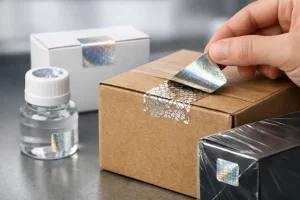
That is why the best packaging labels for FMCG may include barcode labels, RFID-enabled formats, tamper-evident constructions, holographic elements, or void features depending on risk level and channel complexity. Not every product requires these additions, but where authenticity and chain-of-custody matter, standard decorative labels may not be enough.
There is a trade-off here. More security or data functionality can increase specification complexity. But for high-risk products or widely distributed brands, that complexity may be justified by stronger supply chain control and higher confidence in product integrity.
How FMCG buyers should evaluate label options
The most effective evaluation process starts with the product environment. Is the package exposed to refrigeration, oil, abrasion, squeezing, or frequent handling? Next comes pack substrate and geometry. Then application speed, mandatory information load, and shelf presentation requirements.
From there, buyers should assess whether the label needs only branding and compliance support or whether it must also carry traceability and protection functions. This is the point where an experienced manufacturing partner adds measurable value. A supplier with broad label category expertise can align material, adhesive, print process, and finishing requirements into a label structure that performs consistently in production.
For high-volume brands, it also helps to think beyond the launch sample. The right question is not whether the label looks good once. The real question is whether it will apply accurately, remain legible, and preserve brand quality over repeated runs and multiple distribution cycles.
A manufacturer such as Kimoha is positioned to support that level of evaluation because the requirement is rarely limited to one label type. FMCG programs often need a mix of branding, identification, and security-led formats depending on product range and channel exposure.
The best FMCG label is the one that still performs after the carton is opened, the bottle is handled, the code is scanned, and the product reaches the shelf exactly as intended. That is the standard worth specifying against.