
 Food
Food Dairy & Poultry
 Beverage
 Home Care
 Beauty & Personal Care
 Health Care & Pharma
 Transport & Logistics
 Automobile
 Aviation
 Retail
 Exhibitions & Events
 Metal
Metal Garment
 Office Supplies
 Consumer Electronics

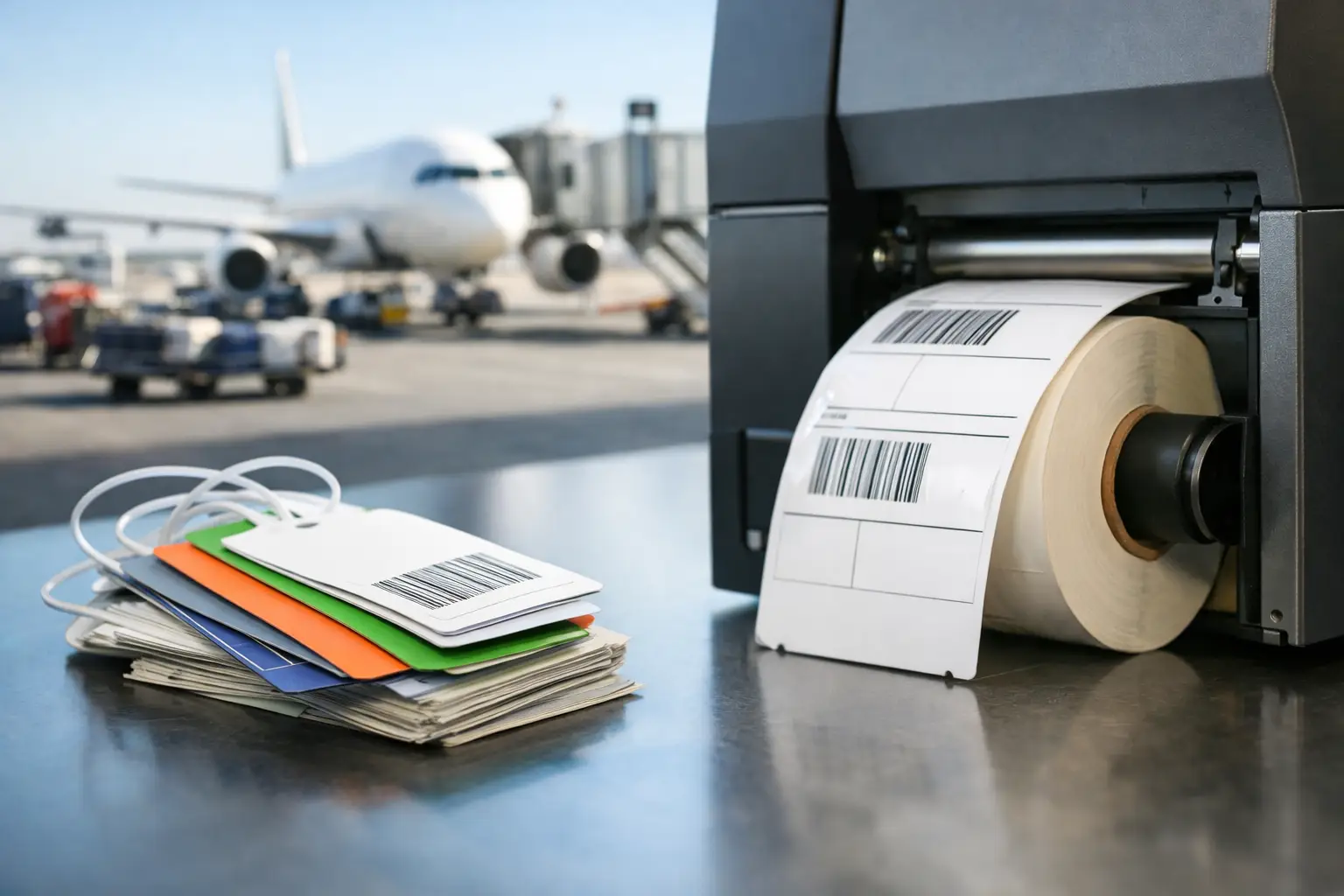
A missed bag is rarely caused by a single failure. More often, it starts with a weak point in identification – a tag that smears, tears, scans poorly, or cannot keep pace with airport handling volumes. That is why choosing an aviation baggage tags manufacturer is not a routine procurement exercise. It is an operational decision that affects traceability, turnaround time, and passenger confidence.
In aviation, the baggage tag sits at the intersection of print engineering, data accuracy, and physical durability. It must survive conveyor systems, manual handling, changing temperatures, abrasion, and exposure to moisture, while still carrying readable information at every checkpoint. For airlines, ground handlers, and airport operators, the manufacturer behind that tag matters far more than the tag’s basic format.
What an aviation baggage tags manufacturer actually delivers
A capable aviation baggage tags manufacturer does not simply print variable information on stock material. The real requirement is a controlled manufacturing process built around aviation use conditions. That includes facestock selection, adhesive performance, release liner consistency, print quality, barcode readability, and compatibility with high-speed application systems.
For enterprise buyers, this distinction matters. A baggage tag is a functional data carrier, not a generic label. It has to perform in a live, high-volume environment where a scanning error can create downstream disruption across sorting, loading, transfer, and claim. Manufacturers serving this category need to understand the operational context, not just the print specification.
That is also where sector specialization becomes valuable. Aviation tags have different demands than warehouse labels or retail barcode stickers. Material choices, perforation accuracy, fanfold behavior, and printer compatibility all need tighter control because the handling environment is harsher and the cost of failure is higher.
The performance standards that matter most
The most visible requirement is scan reliability, but scan reliability depends on multiple upstream factors. Barcode print contrast, edge definition, substrate smoothness, and dimensional consistency all affect read rates. A manufacturer with strong process discipline will focus on these details during production rather than treating them as secondary checks.
Durability is equally critical. Baggage tags are exposed to friction against belts, cages, bins, and other luggage. They may also face humidity, rain exposure on the tarmac, and changes in temperature during transit. If the print fades or the stock splits under stress, the tag stops functioning when it is needed most.
Adhesive behavior requires the same level of attention. In some baggage tag constructions, secure closure must hold through the journey without premature lifting or failure. At the same time, the material still needs to run cleanly through application systems. Overly aggressive adhesives can create feeding issues, while weak adhesion can compromise tag integrity during movement. The right balance depends on printer type, application method, and operational speed.
Why material engineering is not interchangeable
Many buyers initially compare suppliers on output capability alone, but material engineering is where long-term performance is decided. The choice of paper or synthetic stock, coating formulation, tensile strength, and tear resistance all influence how the tag performs under stress.
Paper-based constructions may suit certain operating conditions when cost control and printer compatibility are primary concerns. Synthetic materials can offer better moisture resistance and mechanical strength in more demanding environments. Neither option is universally better. The right selection depends on the route profile, baggage handling intensity, storage conditions, and printer infrastructure already in place.
A serious manufacturer should be able to discuss those trade-offs clearly. If every application is treated with the same material recommendation, that is usually a sign of limited aviation understanding. Good manufacturing partners work backward from the use case and then align stock, adhesive, and print process to the operational requirement.
Aviation baggage tags manufacturer selection and printer compatibility
Printer compatibility is often underestimated until a rollout starts failing on the floor. Baggage tags must work reliably with the airline or airport’s existing print environment, whether that involves thermal printers, hybrid systems, or specific automated tagging equipment. The manufacturer should be able to produce tags with consistent feed characteristics, sensor mark accuracy, and dimensional tolerances that support uninterrupted printing.
This is especially important in high-throughput terminals, where even a small issue like poor perforation or inconsistent gap spacing can slow operations. Procurement teams may view these as production details, but operations teams experience them as downtime.
The best results usually come when manufacturing and operational teams are aligned early. That means validating not only the printed output, but also fanfold stacking, unwind behavior, application speed, and scanner response under realistic conditions. A manufacturer that supports this level of validation is more likely to deliver stable long-term performance.
RFID readiness and the next layer of baggage visibility
As airports and airlines modernize baggage handling, RFID-capable tag solutions are becoming more relevant. Not every baggage program requires RFID today, but many enterprise buyers want a manufacturer that can support future integration without changing suppliers later.
That does not mean every operation should move immediately to RFID. The decision depends on infrastructure maturity, route complexity, asset investment, and the intended visibility gain. For some networks, high-quality barcode tags remain the practical standard. For others, RFID offers measurable advantages in automated tracking and reduced manual intervention.
An experienced manufacturer should be able to support both pathways – conventional baggage tags engineered for consistent scan performance and RFID-enabled constructions designed for read accuracy, encoding reliability, and production scale. Flexibility here is a strategic advantage, especially for aviation stakeholders planning phased upgrades.
Compliance, quality control, and production discipline
Aviation supply chains do not tolerate inconsistency well. That is why quality control in tag manufacturing should be viewed as a core capability, not a back-office function. Buyers should look for disciplined controls around barcode verification, print registration, adhesive consistency, material inspection, and batch traceability.
Production maturity also matters. Manufacturers with established processes are generally better equipped to maintain repeatability across large volumes, multiple dispatches, and changing demand cycles. That becomes essential during peak travel periods, where sudden demand spikes can expose weaknesses in planning or conversion quality.
For regulated and logistics-intensive sectors, manufacturing credibility is built on repeatable output. A supplier may produce an acceptable sample, but enterprise buyers need confidence that the same performance will hold across full production runs. This is where experienced industrial manufacturers separate themselves from general print vendors.
Scale matters, but responsiveness matters too
Large-volume capability is essential in aviation, but scale alone is not enough. The manufacturer also needs to respond quickly to format changes, branding updates, printer adjustments, and operational troubleshooting. Airports and airlines do not work in static conditions. Route changes, baggage system modifications, and equipment upgrades all create new tagging requirements.
A responsive manufacturing partner can adapt without compromising control. That may involve custom dimensions, revised perforation patterns, stronger facestocks, or integration with security and tracking features. The point is not endless customization for its own sake. The point is operational fit.
This is where a specialized manufacturer brings more value than a commodity supplier. Companies such as Kimoha, with established expertise in aviation and industrial labeling, are positioned to support both technical performance and production continuity when baggage identification has to work at scale.
What procurement and operations teams should ask
A useful supplier conversation goes beyond lead time and basic specs. Buyers should ask how the manufacturer validates scan performance, what materials are recommended for specific handling conditions, how printer compatibility is tested, and what controls are in place for consistency across batches.
It also helps to ask how the manufacturer approaches change management. If your network adopts RFID, changes printer hardware, or expands to harsher operating environments, can the supplier adjust without reengineering the entire program from scratch? Strong answers here usually indicate a partner with real category depth.
The best aviation baggage tags manufacturer is not simply the one that can produce tags. It is the one that understands baggage identification as a critical operational system and manufactures accordingly.
A baggage tag is small, but its job is not. When identification needs to survive pressure, motion, and volume, the right manufacturing partner becomes part of the operation itself.