 Food
Food Dairy & Poultry
 Beverage
 Home Care
 Beauty & Personal Care
 Health Care & Pharma
 Transport & Logistics
 Automobile
 Aviation
 Retail
 Exhibitions & Events
 Metal
Metal Garment
 Office Supplies
 Consumer Electronics

A product returned to your warehouse with a clean-looking carton can still be compromised. A retail pack that appears untouched may already have been opened, swapped, or copied. That is why choosing the best security labels for products is not a design exercise. It is a control decision that affects authenticity, traceability, compliance, and customer trust.
For enterprise buyers, the right label depends less on what looks secure and more on what fails visibly, tracks reliably, and performs consistently under real operating conditions. A pharmaceutical carton, an electronics pack, a lubricant container, and an aviation component do not face the same risks. The label strategy should reflect that difference.
What makes the best security labels for products effective
A security label earns its value when it does one or more jobs without ambiguity. It should show evidence of tampering, make counterfeiting harder, support verification, or create a trackable link between the physical product and your internal systems. In many cases, the strongest solution does all four.
The best-performing labels are engineered around the product environment. Adhesive behavior matters. Facestock matters. Print permanence matters. If a label peels cleanly when it should fracture, fades when exposed to chemicals, or loses readability after transit abrasion, it stops being a security feature and becomes a liability.
Security labeling also needs to align with operational reality. A highly advanced label that slows packaging throughput or creates scanning failures on the line may not be the right fit for a high-volume operation. This is where specification discipline matters more than novelty.
The main types of security labels
Tamper-evident labels
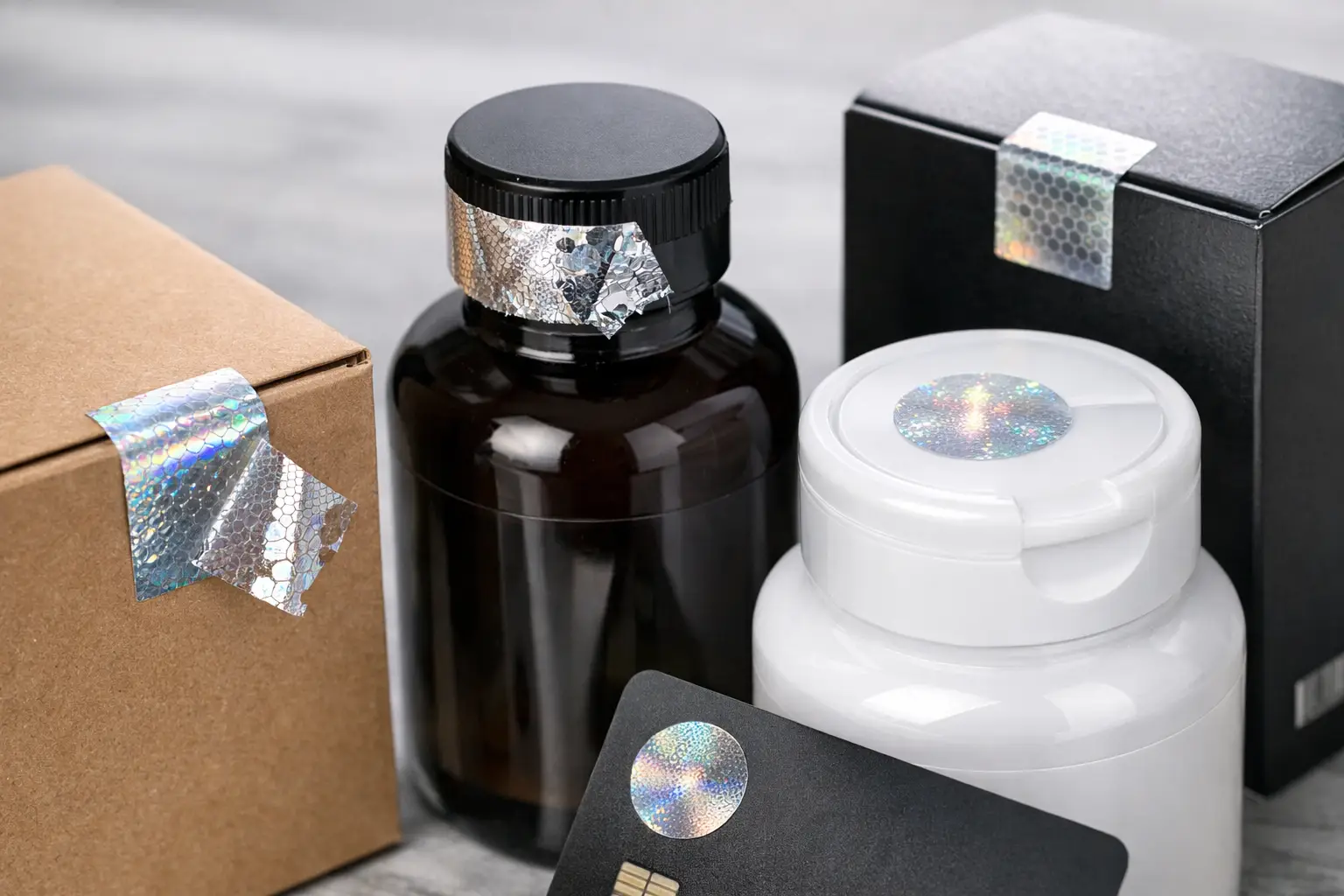
Tamper-evident labels are the foundation of product security for many industries. Their primary function is simple – once applied, any attempt to remove or open the label leaves visible evidence. That evidence may appear as tearing, delamination, residue transfer, or surface distortion.
These labels work well for cartons, closures, pouches, and secondary packaging where unauthorized access is a key risk. In food, pharma, consumer electronics, and retail, they are often the first line of defense because they are easy to inspect and difficult to ignore.
Their strength is clarity. If broken, they communicate a problem immediately. Their limitation is that they do not always confirm product authenticity on their own. They are strongest when paired with serialization, barcodes, or overt visual security features.
Void labels and destructible stickers
Void labels reveal a hidden message such as VOID or OPENED when someone attempts removal. Destructible stickers break into fragments instead of peeling off in one piece. Both are designed to prevent label transfer and make reapplication impractical.
These are among the most effective choices for warranty seals, asset identification, electronics, high-value accessories, and regulated packs where label removal is itself a security event. They create strong forensic evidence and are especially useful when products move through multiple handlers.
The trade-off is substrate sensitivity. Surface energy, texture, and cleanliness affect performance. A void label on powder-coated metal behaves differently than the same construction on corrugated board or molded plastic. Validation is essential before rollout.
Hologram security labels
Hologram labels add a visible authentication layer that is difficult to replicate with standard printing methods. They are widely used for brand protection because they help distributors, retailers, inspectors, and end users distinguish genuine product from suspicious stock.
For sectors exposed to duplication risk, holograms are effective because they combine immediate visual recognition with strong perceived security. They can also be customized with microtext, serial numbering, covert elements, or layered graphics for a more sophisticated defense.
That said, holograms are not a complete anti-counterfeit system by themselves. If there is no method for verification beyond visual inspection, determined bad actors may still attempt imitation. They are best used as part of a broader security architecture rather than as a standalone answer.
Barcode and serialized security labels
Serialized barcode labels give every unit, case, or pallet a distinct identity. This shifts security from a purely visual model to a traceable one. Instead of asking whether a label looks genuine, your teams can verify whether the code exists, where it was assigned, and whether it appears where it should.
This matters in regulated manufacturing, logistics-intensive sectors, and any supply chain where recalls, returns, diversion, or channel leakage are real concerns. Serialization improves accountability across production, warehousing, shipping, and after-market verification.
Its main advantage is system integration. Its challenge is data discipline. If print quality, database management, scan reliability, or code governance are weak, the label loses its value. Security here is as much about process control as material construction.
RFID-enabled security labels
RFID labels extend traceability beyond line-of-sight scanning. They support automated identification, inventory visibility, and movement tracking across high-volume operations. In security applications, RFID can help detect unauthorized movement, verify chain of custody, and reduce manual handling errors.
For logistics, aviation, industrial assets, and selected retail programs, RFID provides a meaningful operational advantage. It is especially useful where speed, batch visibility, and non-contact reading improve control.
Still, RFID is not necessary for every product. It adds complexity and should be justified by the value of automation, the risk profile, and the infrastructure already in place. For many brands, a hybrid model combining visible tamper evidence with digital track-and-trace is more practical than RFID alone.
How to choose the best security labels for products
Start with the threat, not the material. Are you trying to stop covert opening, prevent duplication, control warranty abuse, secure logistics assets, or support regulatory verification? Each objective points toward a different label construction.
Next, look at the application surface and environment. Product security labels must survive temperature variation, moisture, friction, chemical exposure, UV light, and handling stress. A label that performs well in a climate-controlled packing room may fail in cold chain transit, engine oil exposure, or export warehousing.
Then evaluate how the label will be checked. If the audience is a warehouse operator, visual clarity and scan speed matter. If the audience is a customs team or field inspector, overt and covert features may matter more. If the audience is the end consumer, simple visible proof of tampering often carries more value than technical sophistication they cannot verify.
Production scale should also guide the decision. High-volume manufacturing needs labels that apply consistently at speed, maintain print registration, and avoid causing downtime. Security that disrupts throughput is expensive in ways that are not always visible during initial product selection.
Matching label types to common use cases
Pharmaceutical and healthcare packaging typically requires a layered approach. Tamper evidence is essential, but so are serialization, batch traceability, and durable print performance. The label must remain legible and intact through storage, handling, and compliance checks.
Electronics and appliance manufacturers often benefit from destructible warranty seals, void labels, and brand authentication features. These applications need transfer resistance and clear evidence of interference, particularly in service and returns channels.
FMCG, food, and beverage companies usually need security that works at scale without slowing production. Tamper-evident closures, printed batch identifiers, and selective overt features can create a balance between operational efficiency and protection.
For lubricants, automotive products, industrial chemicals, and export goods, material durability becomes a bigger issue. Labels may face oils, abrasion, outdoor exposure, and aggressive handling. In these environments, construction quality matters just as much as the security mechanism itself.
High-control sectors such as aviation, logistics, and enterprise asset tracking often require identification that supports both security and movement visibility. This is where barcode, RFID, and tamper-evident formats can work together rather than as isolated tools.
Why custom engineering usually outperforms off-the-shelf options
Security labels are rarely one-size-fits-all in serious industrial use. Stock formats may be acceptable for low-risk applications, but enterprise environments usually need tighter control over adhesive selection, substrate compatibility, print technology, variable data, and failure behavior.
A custom-engineered label can be designed around line speed, product geometry, inspection requirements, and environmental stress. It can also combine overt, covert, and digital features in a way that reflects actual business risk instead of generic assumptions.
This is where manufacturing capability matters. A security label is not just artwork with adhesive. It is a precision-built component of the packaging and identification system. Suppliers with experience in high-performance industrial labeling are better positioned to align print quality, material science, and application reliability at commercial scale. That is why companies with deep category expertise, such as Kimoha, are often involved early when product protection needs to be built for both performance and volume.
The strongest choice is usually not the most complex label. It is the label that fits your risk profile, your product surface, your verification process, and your production reality without compromise. If your current label can be removed cleanly, copied easily, or tracked inconsistently, that is a signal to re-specify before the market exposes the gap.