 Food
Food Dairy & Poultry
 Beverage
 Home Care
 Beauty & Personal Care
 Health Care & Pharma
 Transport & Logistics
 Automobile
 Aviation
 Retail
 Exhibitions & Events
 Metal
Metal Garment
 Office Supplies
 Consumer Electronics


A surprising number of label specifications get delayed for one simple reason: teams are debating two names for what is often the same product class. When buyers ask about pressure sensitive labels vs self adhesive, the real issue is usually not which one is “better.” It is whether everyone in procurement, packaging, compliance, and production is using the same terminology – and whether the label construction matches the application.
In most commercial and industrial settings, pressure-sensitive labels and self-adhesive labels refer to the same basic labeling format. These labels come with a pre-applied adhesive that bonds to a surface when pressure is applied by hand, roller, or automatic applicator. They do not require water, heat, or solvent activation. That is why both terms are widely used across packaging, logistics, pharma, food, retail, and security labeling.
Pressure sensitive labels vs self adhesive: is there a real difference?
From a technical standpoint, the overlap is significant. A pressure-sensitive label is self-adhesive because it already carries adhesive on the back. A self-adhesive label is pressure-sensitive because it adheres when pressure is applied. In everyday B2B use, these terms are often interchangeable.
Where confusion starts is in specification detail. Some buyers use “self-adhesive” as a broad commercial term and “pressure-sensitive” as a more technical manufacturing term. Others assume pressure-sensitive refers only to premium constructions or industrial-grade applications. That assumption is not necessarily accurate.
What matters more than the label name is the full build: facestock, adhesive type, liner, print method, finish, release performance, and end-use environment. If a label has to survive cold chain handling, chemical exposure, outdoor storage, tamper attempts, or automated high-speed dispensing, terminology alone will not protect performance.
What both label types actually are
Both pressure-sensitive and self-adhesive labels are typically built from the same core components.
The facestock is the printable surface, which may be paper, film, foil, or a specialty material. The adhesive sits beneath it and is designed for permanent, removable, freezer-grade, high-tack, or application-specific performance. The liner protects the adhesive until the label is dispensed. Once applied, the label bonds through pressure rather than activation by moisture or heat.
This construction makes the format highly efficient for modern operations. It works well with variable data printing, barcode systems, batch coding, branding graphics, compliance information, and security features. It also supports both manual application and large-scale automated runs.
That is why these labels dominate so many sectors. They are fast to apply, versatile in material choice, and adaptable to a wide range of packaging shapes and production environments.
Why the terminology still matters in procurement
Even if the two terms point to the same category, language still affects sourcing. Procurement teams often compare quotes from multiple suppliers, and inconsistent wording can create false differences. One vendor may quote “self-adhesive labels” while another quotes “pressure-sensitive labels” for an almost identical construction. Without reviewing the material stack and performance criteria, buyers can end up comparing names instead of specifications.
For regulated industries, that risk is greater. Pharmaceutical, food, chemical, aviation, and security applications require tighter control over adhesion, print permanence, tamper evidence, and traceability. In those environments, every label request should move beyond terminology and into performance requirements.
A better buying conversation sounds like this: What surface is the label applied to? What are the temperature conditions during application and use? Is the surface curved, textured, oily, frozen, or corrugated? Does the label need to resist moisture, abrasion, UV, chemicals, or attempted removal? Will it be applied by hand or machine? Those answers matter far more than whether the request says self-adhesive or pressure-sensitive.
When a pressure-sensitive label is the right fit
Pressure-sensitive labels are especially effective when application speed, print quality, and flexibility are priorities. In FMCG and retail packaging, they support high visual impact while running efficiently on automated lines. In logistics, they enable barcode readability and consistent adhesion across cartons, pallets, and shipping units. In pharma and medical packaging, they can carry critical information, serialization data, and compliance content with precision.
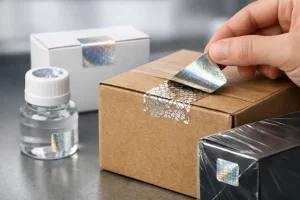
They are also a strong fit for specialty applications. Security seals, void labels, tamper-evident constructions, RFID-enabled labels, and brand protection formats are commonly produced in pressure-sensitive form because they allow controlled adhesive behavior and engineered material combinations.
For enterprise buyers, the value is not just convenience. It is process reliability. A well-engineered pressure-sensitive construction reduces misapplication, label lift, scanning failures, and field complaints. That translates directly into operational efficiency.
When “self-adhesive” may be used as the preferred term
Many commercial teams, packaging buyers, and regional distributors simply use “self-adhesive labels” because it is more intuitive. It clearly tells non-technical stakeholders that the label already has glue on the back and does not need separate activation. In sales conversations, that wording can be useful because it is immediately understood across departments.
There is nothing wrong with the term. The issue arises only when teams stop at the label name and skip the technical discussion. A self-adhesive label for a dry folding carton and a self-adhesive label for a refrigerated dairy container may sound similar on paper, but they can require very different adhesives and face materials.
In other words, “self-adhesive” is a valid category term. It is just not a specification by itself.
The real decision points are performance-based
If your team is evaluating pressure sensitive labels vs self adhesive, the decision should shift quickly to application conditions.
Adhesive selection is usually the first critical variable. Permanent adhesives are suited for long-term bonding and supply chain durability. Removable adhesives work where clean removal is required, such as promotional overlays or temporary identification. Specialty adhesives are often needed for low-temperature application, rough substrates, high-moisture environments, or surfaces with low surface energy.
Material choice is equally important. Paper labels may be cost-effective and print well for general packaging, but filmic labels often perform better where moisture resistance, tear resistance, or outdoor durability is required. For chemical containers, lubricants, bath products, and industrial packaging, film can offer a much stronger service life.
Application method also changes the label build. A label designed for manual application may not dispense cleanly at high line speeds unless the liner, adhesive coat weight, and die-cutting are engineered for machine performance. For large-volume operations, this is where manufacturing expertise matters.
Industry-specific examples
In food and beverage, pressure-sensitive or self-adhesive labels are commonly used for branding, ingredient panels, date coding, and traceability. But the right construction depends on whether the container is glass, PET, HDPE, flexible film, or corrugated secondary packaging. Condensation, refrigeration, and product handling all affect adhesive behavior.
In pharmaceuticals, label performance is tied to compliance. Legibility, adhesive consistency, resistance to smudging, and compatibility with variable data printing are all essential. Here, a generic request for self-adhesive labels is not enough. The application demands engineered precision.
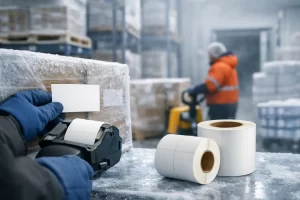
In logistics and warehousing, barcode labels must remain attached and scannable throughout movement, stacking, and shipment. Surface variation and handling stress can quickly expose weak adhesive selection.
In security labeling, the pressure-sensitive format enables more advanced constructions such as destructible materials, holographic layers, and void patterns. These applications are less about terminology and more about controlled failure behavior, authentication, and tamper visibility.
How to avoid mistakes when sourcing
The most effective approach is to treat both terms as entry points, not final definitions. Start by confirming whether the supplier understands your operating conditions, substrate, compliance requirements, print process, and application speed. Then review sample constructions under actual use conditions, not only in a conference room.
Ask for performance alignment rather than a generic product type. A capable manufacturing partner should be able to guide adhesive selection, recommend face materials, account for dispensing conditions, and validate print compatibility. That is particularly important when labels support traceability, brand presentation, or product integrity.
For large-volume or mission-critical programs, consistency across batches is just as important as initial adhesion. Industrial buyers should look for production maturity, process control, and the ability to scale without variation in print registration, die accuracy, or adhesive performance. That is where an experienced producer such as Kimoha adds practical value beyond supply.
The clearer question to ask
Instead of asking whether pressure-sensitive labels are different from self-adhesive labels, ask what label construction is best for your product, surface, environment, and line conditions. In most cases, the two terms describe the same label family. The winning choice comes from engineering the right combination of material, adhesive, print method, and application performance.
That shift in thinking usually saves more time than any terminology debate – and it leads to labels that actually perform where it counts: on the line, in transit, on the shelf, and in the field.